November 5, 2025
November 5, 2025
A little universe, just for you
Free PNG · 1080 × 1350 · No account needed
Image rights and credit requirements apply when sharing or reusing imagery.
Your celebration date stays the same. Each image keeps its actual publication date.
Selected image source ↗ APOD published November 5, 2025. Full image credits are on the original APOD entry below. A publication-date match, not a photo taken on your date. Independent of NASA.
Read the original APOD for the astronomer’s explanation and full image credits. Its text is preserved in the archive as published.
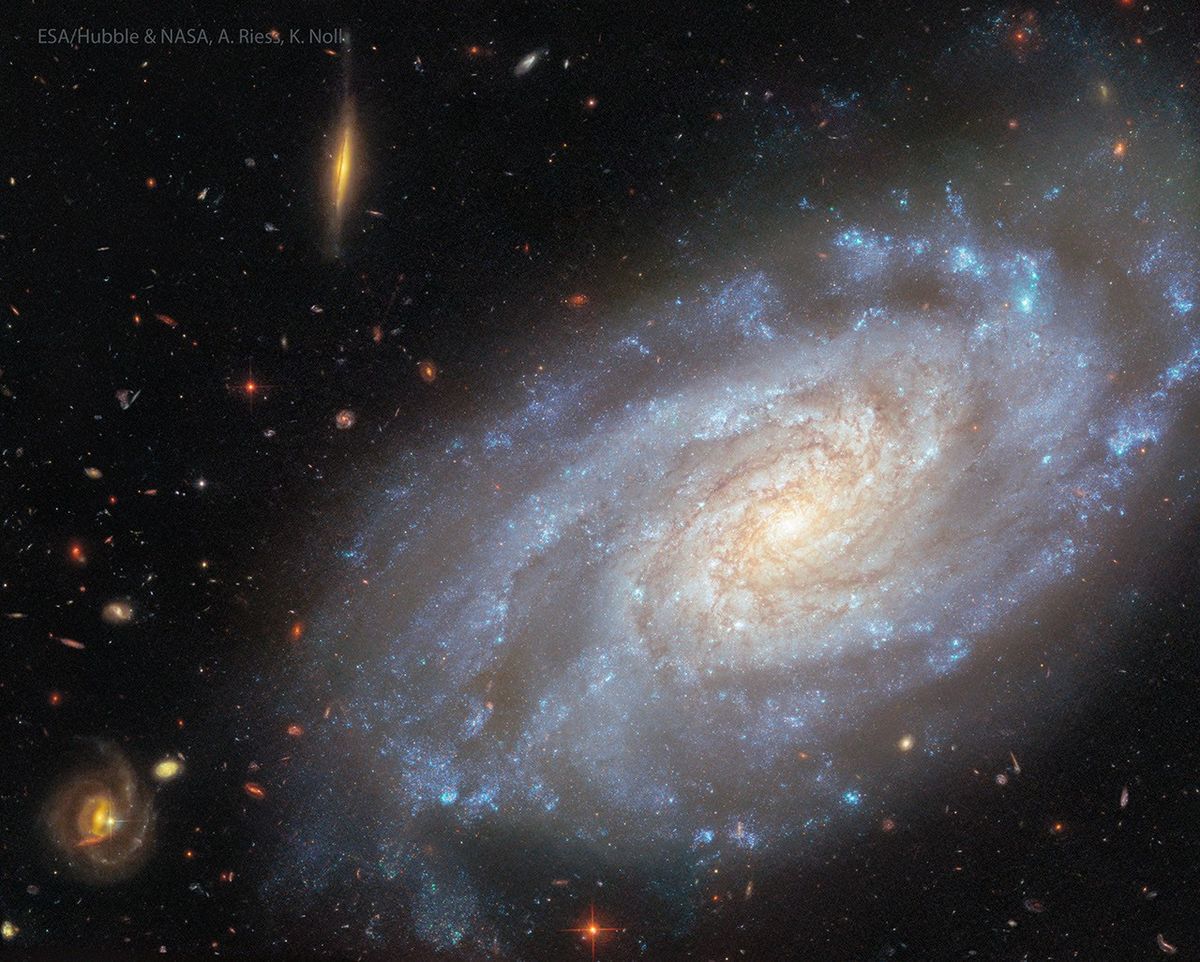
Is this what our own Milky Way Galaxy looks like from far away? Similar in size and grand design to our home Galaxy (although without the central bar), spiral galaxy NGC 3370 lies about 100 million light-years away toward the constellation of the Lion (Leo). Recorded here in exquisite detail by the Hubble Space Telescope, the big, beautiful face-on spiral is not only photogenic, but has proven sharp enough to study individual stars known as Cepheids. These pulsating stars have been used to accurately determine NGC 3370's distance. NGC 3370 was chosen for this study because in 1994 the spiral galaxy was also home to a well studied stellar explosion -- a Type Ia supernova. Combining the known distance to this standard candle supernova, based on the Cepheid measurements, with observations of supernovas at even greater distances has helped to reveal the size and expansion rate of the entire Universe itself.
Updated · APOD entries through