November 15, 2025
November 15, 2025
A little universe, just for you
Free PNG · 1080 × 1350 · No account needed
Image rights and credit requirements apply when sharing or reusing imagery.
Your celebration date stays the same. Each image keeps its actual publication date.
Selected image source ↗ APOD published November 15, 2025. Credit: Piotr Czerski. A publication-date match, not a photo taken on your date. Independent of NASA.
Read the original APOD for the astronomer’s explanation and full image credits. Its text is preserved in the archive as published.
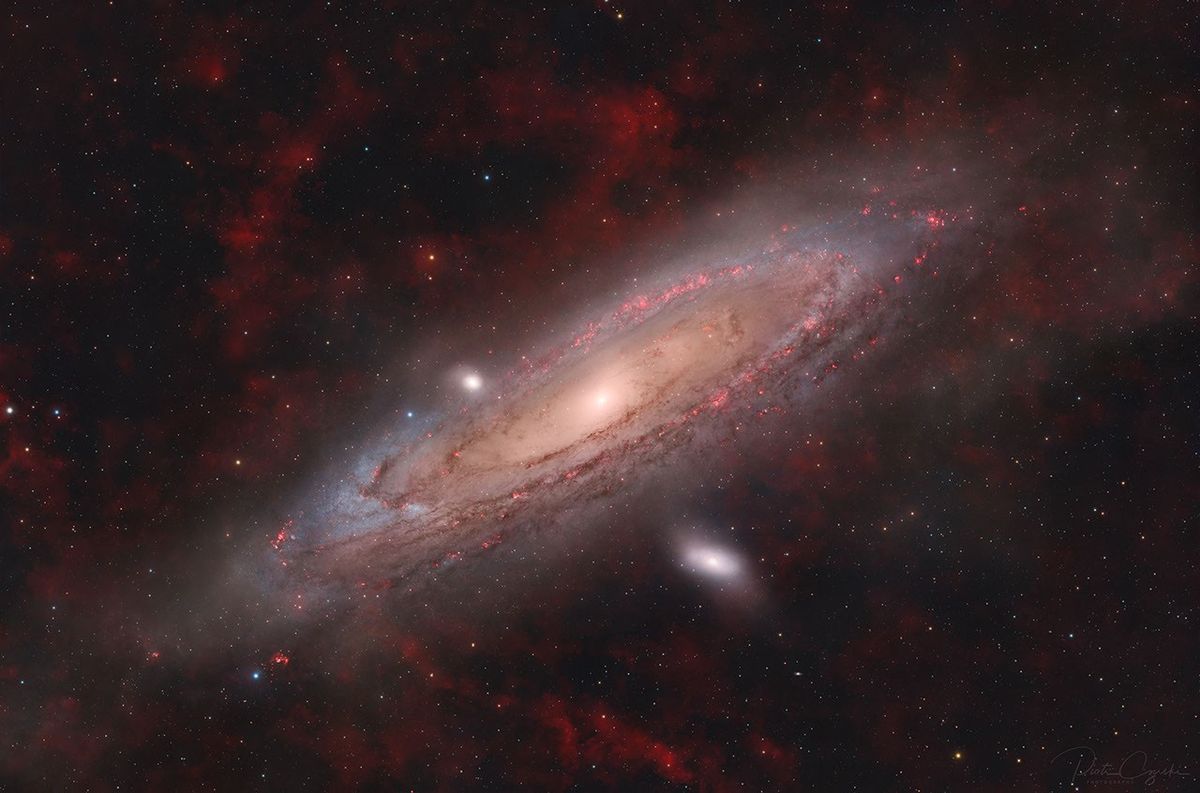
This magnificent extragalactic skyscape looks toward the Andromeda Galaxy, the closest large spiral galaxy to the Milky Way. It also accomplishes a Messier catalog trifecta by including Andromeda, cataloged as Messier 31 (M31), along with Messier 32 (M32), and Messier 110 (M110) in the same telescopic field of view. In this frame, M32 is just left of the Andromeda Galaxy's bright core with M110 below and to the right. M32 and M110 are both elliptical galaxies themselves and satellites of the larger spiral Andromeda. By combining 60 hours of broadband and narrowband image data, the deep telescopic view also reveals tantalizing details of dust lanes, young star clusters, and star-forming regions along Andromeda's spiral arms, and faint, foreground clouds of glowing hydrogen gas. For now, Andromeda and friends are some 2.5 million light-years from our own large spiral Milky Way. Fun Fact: It has been 11,111 days since APOD was founded.
Image credit: Piotr Czerski
Updated · APOD entries through