November 12, 2025
November 12, 2025
A little universe, just for you
Free PNG · 1080 × 1350 · No account needed
Image rights and credit requirements apply when sharing or reusing imagery.
Your celebration date stays the same. Each image keeps its actual publication date.
Selected image source ↗ APOD published November 12, 2025. Credit: Eric Houck. A publication-date match, not a photo taken on your date. Independent of NASA.
Read the original APOD for the astronomer’s explanation and full image credits. Its text is preserved in the archive as published.
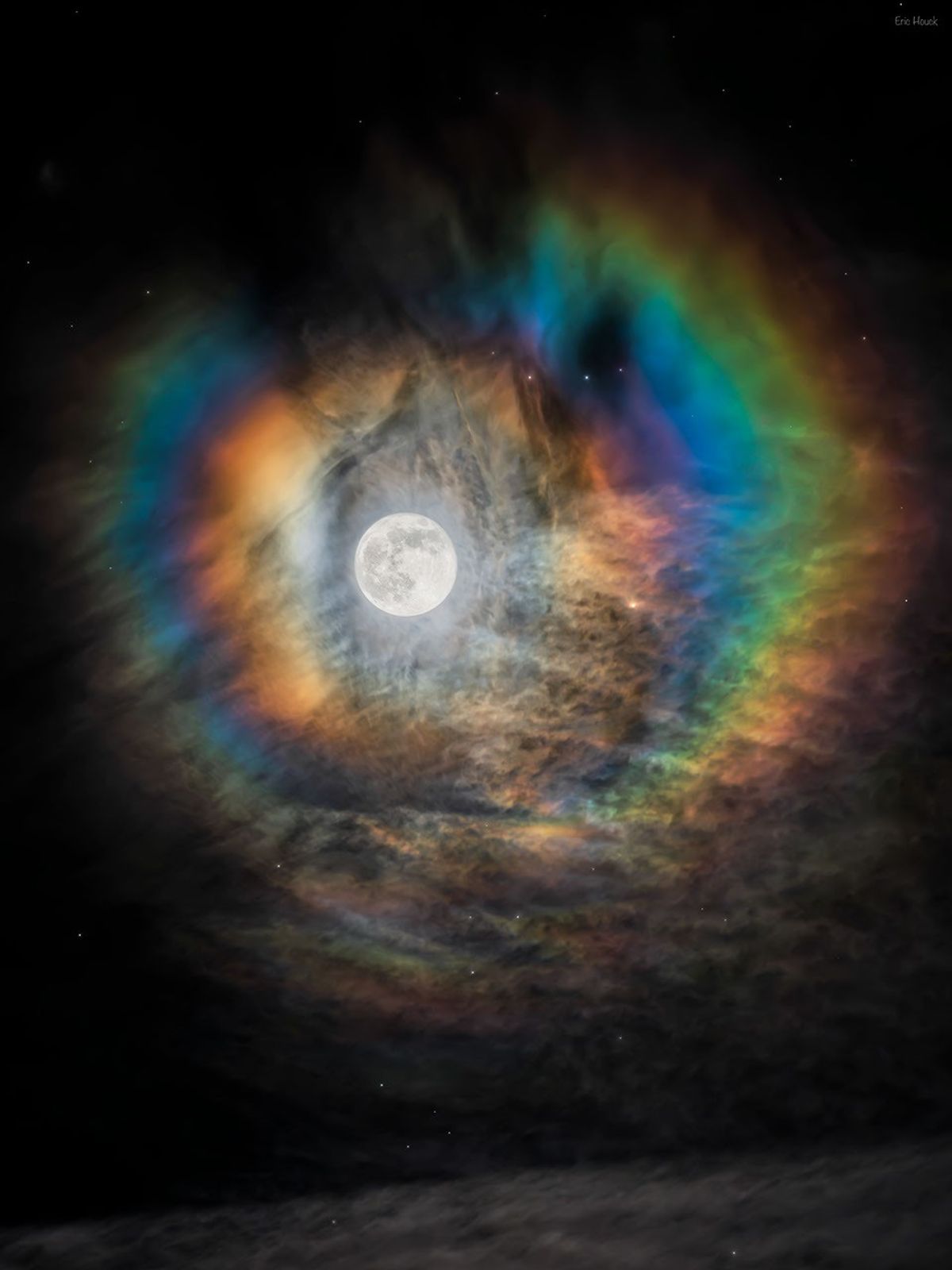
What are those colorful rings around the Moon? A corona. Rings like this will sometimes appear when the Moon is seen through thin clouds. The effect is created by the diffraction of light around individual, similarly-sized water droplets in an intervening but mostly transparent cloud. Since light of different colors has different wavelengths, each color diffracts differently. Lunar coronae are one of the few color diffraction effects that can be easily seen with the unaided eye. The featured image of a lunar corona was captured around last week's full Super Moon from near Knight's Ferry, California, USA. To the right of the full Moon is the giant orange star Botein. Similar coronae that form around the Sun are typically harder to see because of the Sun's great brightness.
Image credit: Eric Houck
Updated · APOD entries through