May 8, 2026
May 8, 2026
A little universe, just for you
Free PNG · 1080 × 1350 · No account needed
Image rights and credit requirements apply when sharing or reusing imagery.
Your celebration date stays the same. Each image keeps its actual publication date.
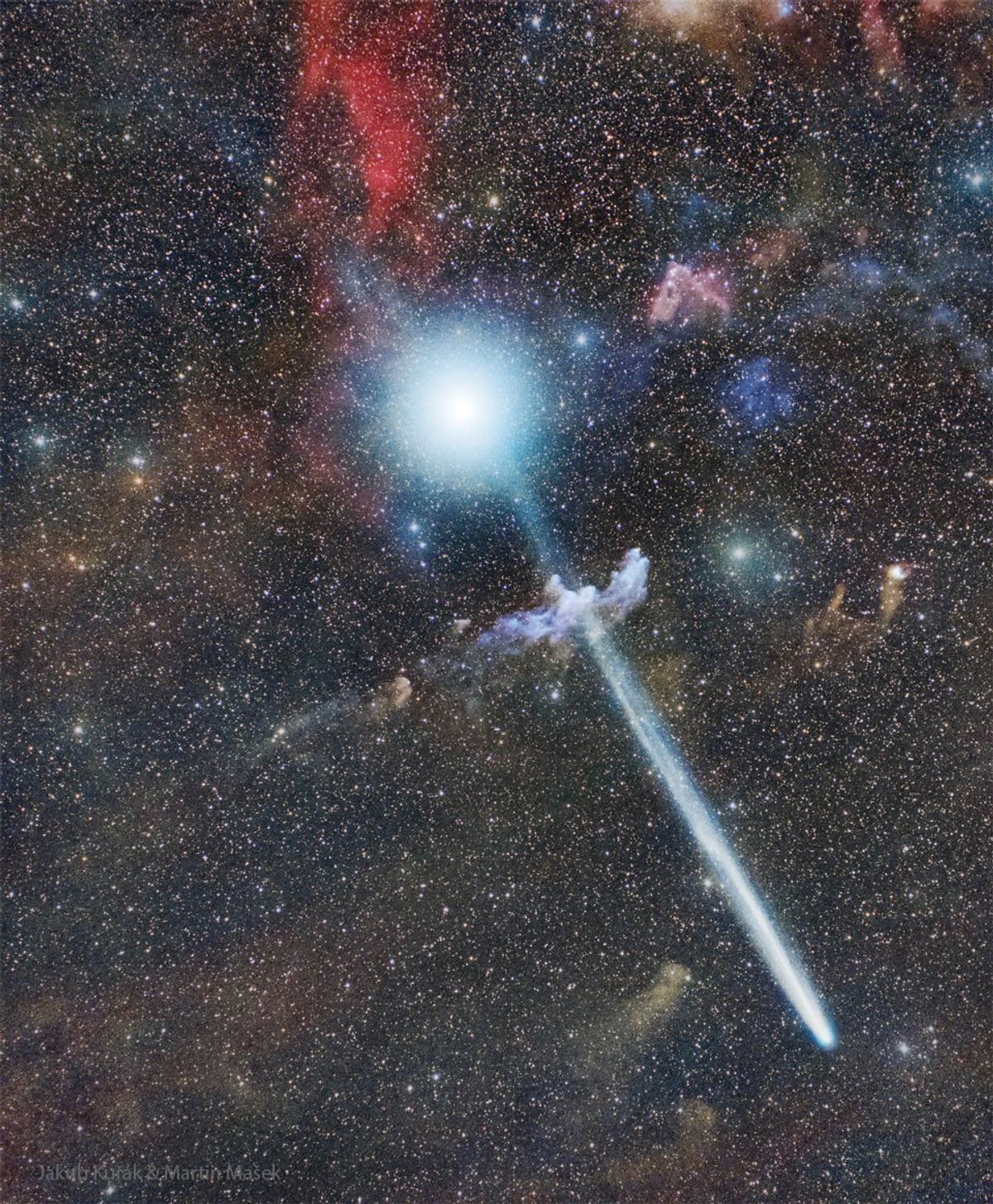
Selected image source ↗ APOD published May 8, 2026. Credit: Jakub Kuřák & Martin Mašek (FZU of the Czech Academy of Sciences). A publication-date match, not a photo taken on your date. Independent of NASA.
Read the original APOD for the astronomer’s explanation and full image credits. Its text is preserved in the archive as published.
Which way is Comet R3 PanSTARRS going? Not towards the star at the top of the image, because that is Rigel, which, being far in the background, is unrelated to the comet. Not through the nebula in the image middle, because that is the Witch Head Nebula and it, too, is far in the distance -- but not far from Rigel. Not into northern skies because over the past week Comet C/2025 R3 (PanSTARRS) has moved into southern skies and is now best visible in Earth's Southern Hemisphere toward the west after sunset. Angularly, Comet R3 PanSTARRS is slowly moving toward the upper right, night by night, and will soon be in the constellation Orion. Spatially, the comet is now headed out of our Solar System but should remain visible to cameras in southern skies for about a week. The featured image was captured last week near Cerro Paranal in Chile. Growing Gallery: Comet R3 PanSTARRS in 2026
Image credit: Jakub Kuřák & Martin Mašek (FZU of the Czech Academy of Sciences)
Updated · APOD entries through