May 25, 2026
May 25, 2026
A little universe, just for you
Free PNG · 1080 × 1350 · No account needed
Image rights and credit requirements apply when sharing or reusing imagery.
Your celebration date stays the same. Each image keeps its actual publication date.
Selected image source ↗ APOD published May 25, 2026. Credit: John Hayes. A publication-date match, not a photo taken on your date. Independent of NASA.
Read the original APOD for the astronomer’s explanation and full image credits. Its text is preserved in the archive as published.
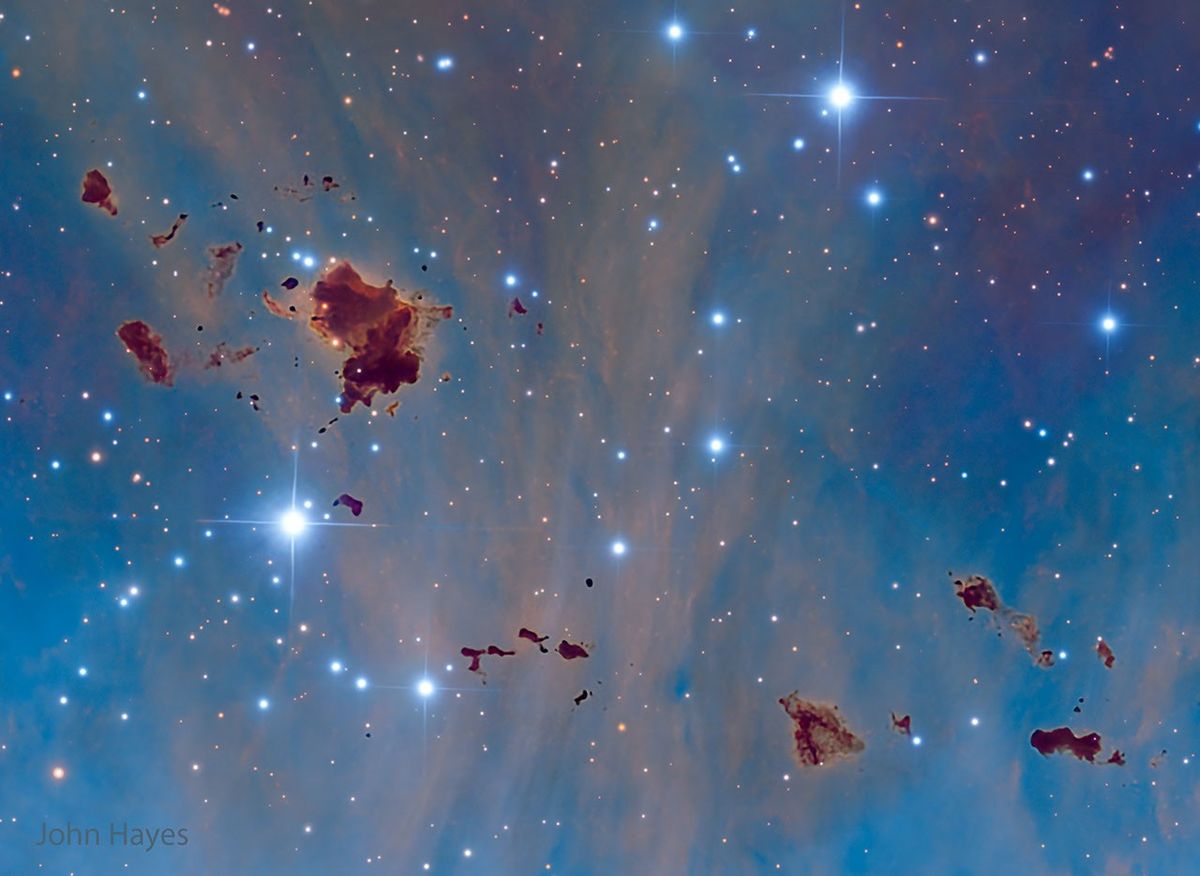
What are these strange space globs? Situated in rich star fields and glowing hydrogen gas, these opaque clouds of interstellar dust and gas are so large they might be able to form stars. Their home is known as IC 2944, a bright stellar nursery located about 7,600 light years away toward the constellation of the Centaur (Centaurus). The largest of these dark globules, first spotted by A. D. Thackeray in 1950 using a telescope in South Africa, is likely two separate but overlapping clouds, each more than one light-year wide. Along with other data, the featured Hubble palette image from the El Sauce Observatory in Chile, indicates that Thackeray's globules are fractured and churning as a result of intense ultraviolet radiation from young, hot stars already energizing and heating the bright emission nebula. These and similar dark globules known to be associated with other star forming regions may ultimately be dissipated by their hostile environment -- like cosmic lumps of butter in a hot frying pan. Interstellar Jigsaw: Astronomy Puzzle of the Day
Image credit: John Hayes
Updated · APOD entries through