March 9, 2026
March 9, 2026
A little universe, just for you
Free PNG · 1080 × 1350 · No account needed
Image rights and credit requirements apply when sharing or reusing imagery.
Your celebration date stays the same. Each image keeps its actual publication date.
Selected image source ↗ APOD published March 9, 2026. Full image credits are on the original APOD entry below. A publication-date match, not a photo taken on your date. Independent of NASA.
Read the original APOD for the astronomer’s explanation and full image credits. Its text is preserved in the archive as published.
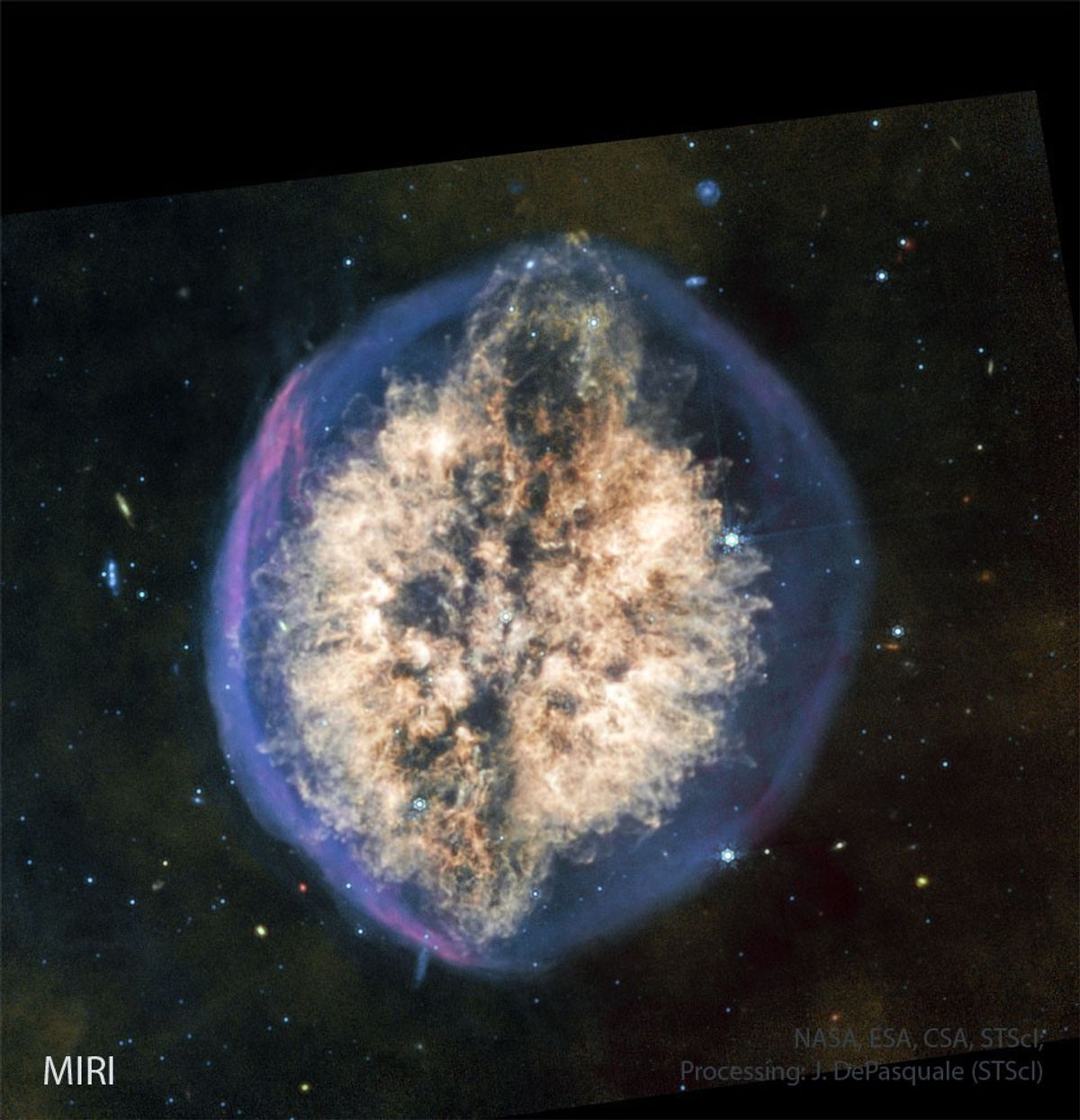
What's going on inside the head of this nebula? Dubbed the Exposed Cranium Nebula for its similarity to the human brain, what created the nebula remains a mystery. One thought is that the Cranium Nebula, also known as PMR 1, is a planetary nebula surrounding a white dwarf star. In this mode, the outer atmosphere was expelled when the original Sun-like star ran out of central nuclear fuel and contracted. A competing thought is that the central star is much more massive, possibly a Wolf-Rayet star, that is ejecting gas and dust via turbulent stellar winds. Adding to the intrigue is the dark vertical central division and the thin outer gaseous shell. The featured image was taken by the Webb Space Telescope in mid- infrared light, while a second image, included as a rollover, is in near-infrared. Future observations may reveal if this brainy system will quietly just fade from view or, many years from now, suddenly erupt in a powerful supernova.
Updated · APOD entries through