March 7, 2026
March 7, 2026
A little universe, just for you
Free PNG · 1080 × 1350 · No account needed
Image rights and credit requirements apply when sharing or reusing imagery.
Your celebration date stays the same. Each image keeps its actual publication date.
Selected image source ↗ APOD published March 7, 2026. Credit: Tunc Tezel. A publication-date match, not a photo taken on your date. Independent of NASA.
Read the original APOD for the astronomer’s explanation and full image credits. Its text is preserved in the archive as published.
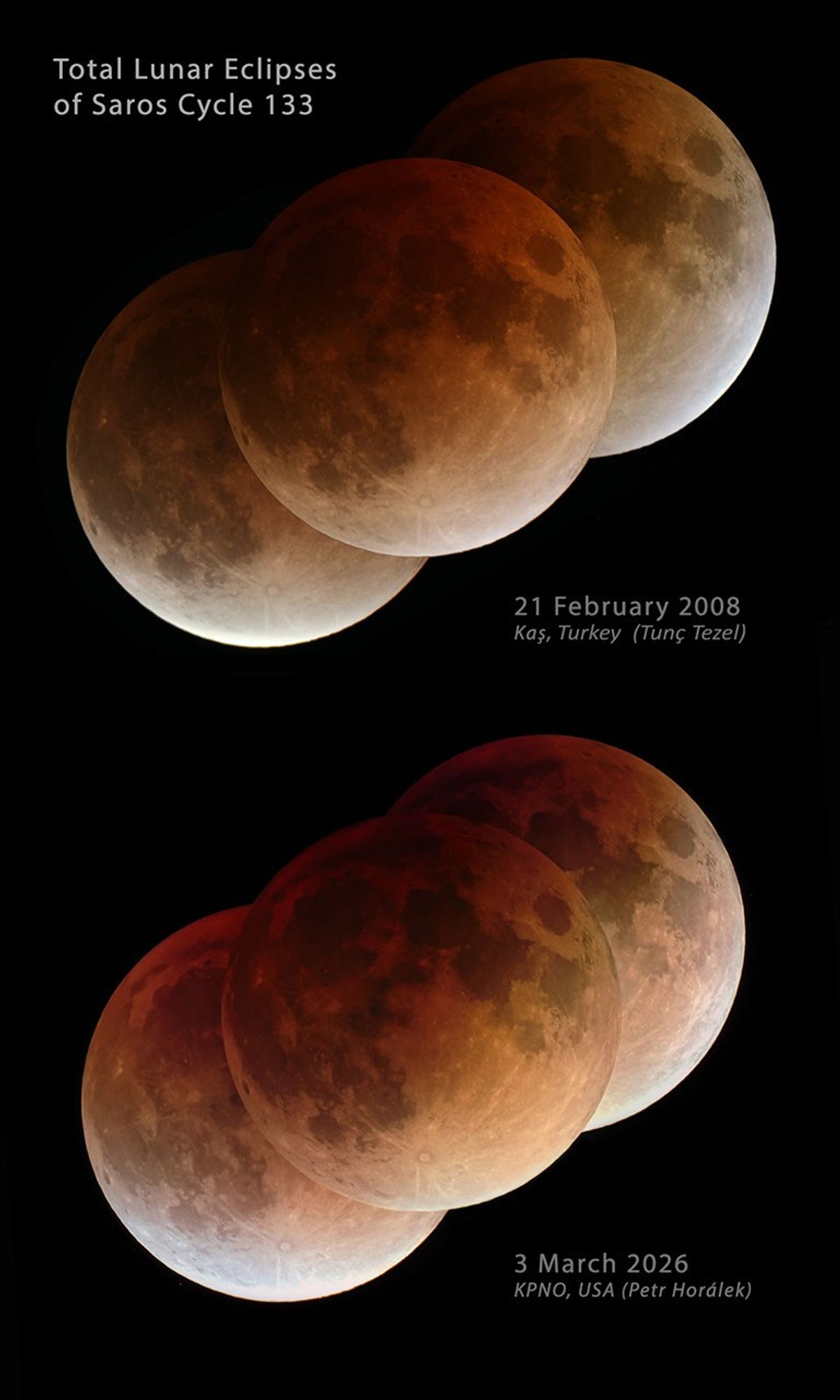
Centered on maximum eclipse, these two total lunar eclipse sequences look almost identical. Yet the one shown on top is composed of images recorded in February 2008, while at the bottom is the recent March 2026 total eclipse of the Moon. Why are they so similar? Because these two total lunar eclipses are from the same Saros cycle. The Saros cycle was discovered historically from observations of the Moon's orbit. With a period of 18 years, 11 and 1/3 days, the cycle predicts when the Sun, Earth, and Moon all return to the same relative geometry for a lunar (or solar) eclipse. Eclipses separated by one Saros period belong to the same numbered Saros series, in this case Saros 133. So expect the next lunar eclipse in Saros 133 to be a repeat of this year's March 3 eclipse. You can watch the next Saros 133 total lunar eclipse on March 13, 2044. Growing Gallery: Total Lunar Eclipse of March 3
Image credit: Tunc Tezel
Updated · APOD entries through