March 4, 2026
March 4, 2026
A little universe, just for you
Free PNG · 1080 × 1350 · No account needed
Image rights and credit requirements apply when sharing or reusing imagery.
Your celebration date stays the same. Each image keeps its actual publication date.
Selected image source ↗ APOD published March 4, 2026. Credit: Peter Bresseler; Text: Keighley Rockcliffe (NASA GSFC, UMBC CSST, CRESST II). A publication-date match, not a photo taken on your date. Independent of NASA.
Read the original APOD for the astronomer’s explanation and full image credits. Its text is preserved in the archive as published.
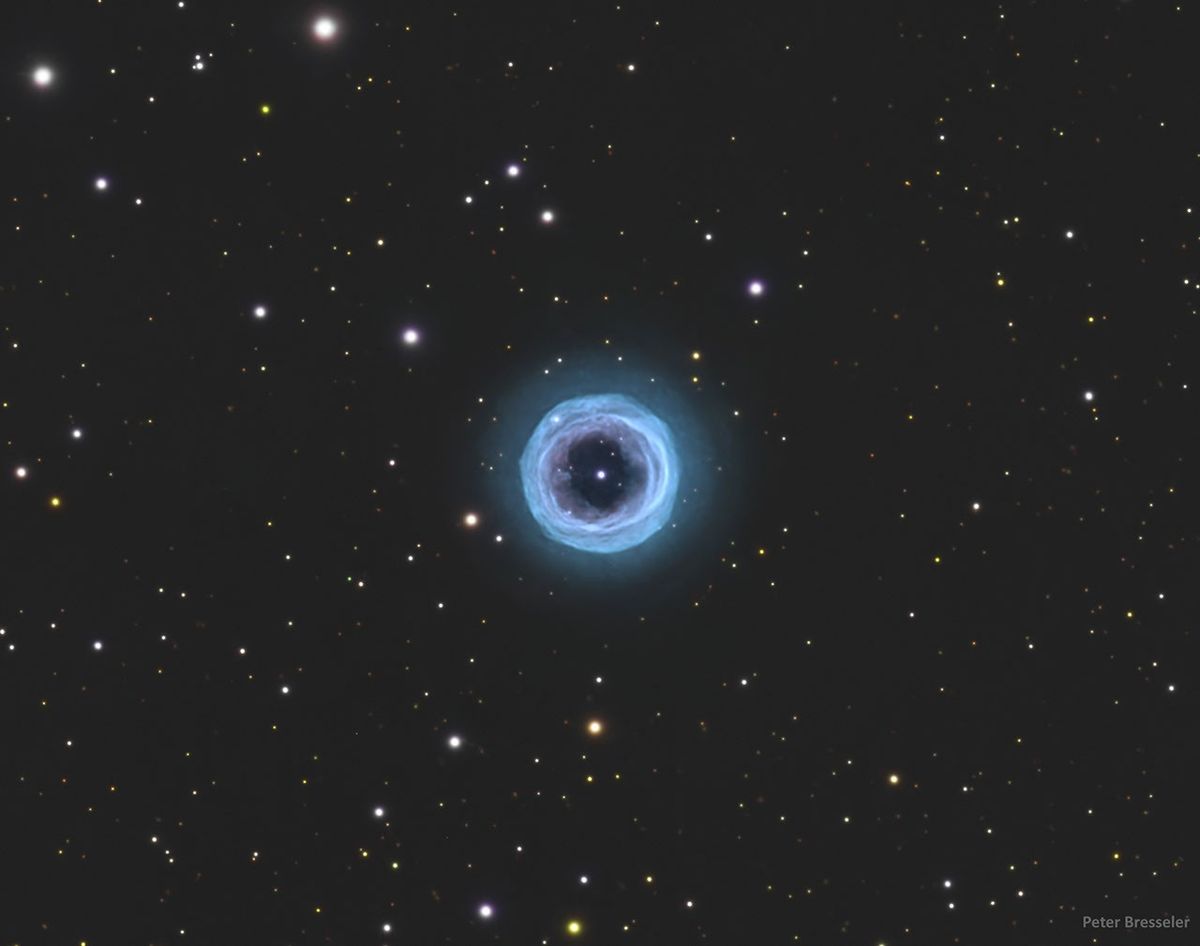
What’s looking back at you isn’t a cosmic eye, but Shapley 1, a beautifully symmetric planetary nebula. Shapley 1, also known as the Fine Ring Nebula or PLN 329+2.1, bejewels the southern sky constellation of the Carpenter's Square (Norma). The nebula is the result of a star near the mass of our Sun running out of fuel and shedding its outer layers. Glowing oxygen from those expelled layers makes up the circular halo. The bright central point is actually a binary: a white dwarf, the remaining stellar core after the outer layers are expelled into space, and another star, orbiting each other every 2.9 days. Shapley 1’s annular shape is due to our top-down view of the system and provides insight into the influence of central stars on planetary nebula structures.
Image credit: Peter Bresseler; Text: Keighley Rockcliffe (NASA GSFC, UMBC CSST, CRESST II)
Updated · APOD entries through