March 31, 2026
March 31, 2026
A little universe, just for you
Free PNG · 1080 × 1350 · No account needed
Image rights and credit requirements apply when sharing or reusing imagery.
Your celebration date stays the same. Each image keeps its actual publication date.
Selected image source ↗ APOD published March 31, 2026. Full image credits are on the original APOD entry below. A publication-date match, not a photo taken on your date. Independent of NASA.
Read the original APOD for the astronomer’s explanation and full image credits. Its text is preserved in the archive as published.
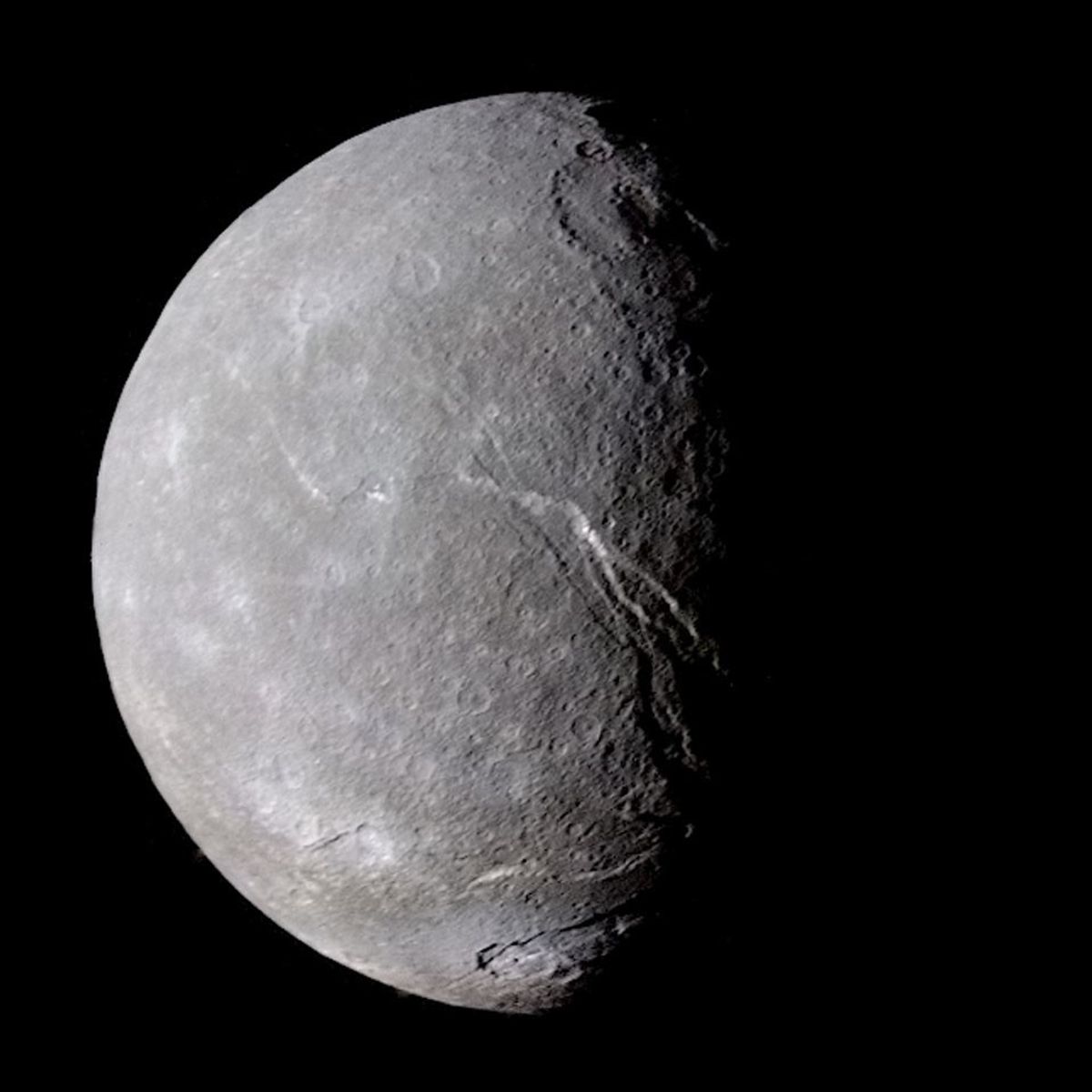
Titania's tortured terrain is a mix of canyons, cliffs, and craters. NASA's interplanetary robot spacecraft Voyager 2 passed the largest moon of Uranus in 1986 and took the feature picture. That the trenches of Titania resemble those on another moon of Uranus, Ariel, indicate that Titania underwent some violent surface event possibly related to water freezing and expanding in its distant past. Although Titania is Uranus's largest moon, it is only about half the radius of Triton - the largest moon of Uranus's sister planet Neptune, which itself is slightly smaller than Earth's Moon. Titania, discovered by William Herschel in 1787, is essentially a large dirty iceball that is composed of about half water-ice and half rock. There is recent speculation that radioactive heating melts some underground ice into oceans.
Updated · APOD entries through