March 21, 2026
March 21, 2026
A little universe, just for you
Free PNG · 1080 × 1350 · No account needed
Image rights and credit requirements apply when sharing or reusing imagery.
Your celebration date stays the same. Each image keeps its actual publication date.
Selected image source ↗ APOD published March 21, 2026. Credit: Dietmar Hager and Eric Benson. A publication-date match, not a photo taken on your date. Independent of NASA.
Behind the original result
Read the original APOD for the astronomer’s explanation and full image credits. Its text is preserved in the archive as published.
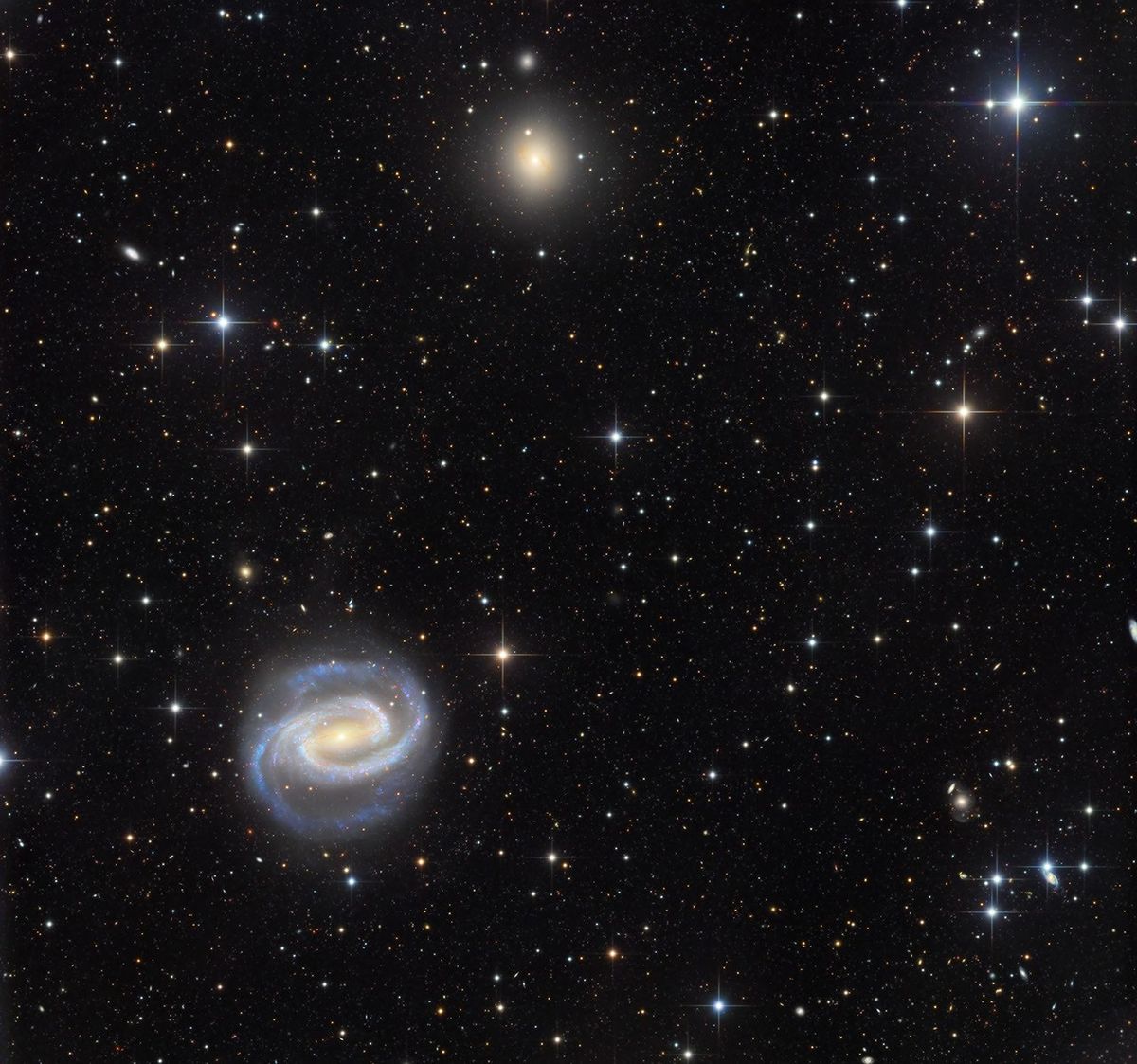
Spiral NGC 1300 and elliptical NGC 1297 are galaxies that lie on the banks of the southern constellation Eridanus (The River). At 70 million light-years distant or more, both are members of the Eridanus Galaxy Cluster. About 100,000 light-years across, at lower left in this sharp, galaxy group photo NGC 1300 is seen face-on with a prominent central bar and grand, sweeping spiral arms. Like other spiral galaxies, including our own barred spiral Milky Way Galaxy, NGC 1300 is thought to have a supermassive central black hole. A contrast in appearance and slightly more distant, NGC 1297 is the roughly spherical large elliptical galaxy near the top of the frame. With little active star formation, elliptical galaxies are composed of older populations of stars and are likely he result of multiple collisions and mergers with spirals.
Image credit: Dietmar Hager and Eric Benson
Updated · APOD entries through