June 2, 2026
June 2, 2026
A little universe, just for you
Free PNG · 1080 × 1350 · No account needed
Image rights and credit requirements apply when sharing or reusing imagery.
Your celebration date stays the same. Each image keeps its actual publication date.
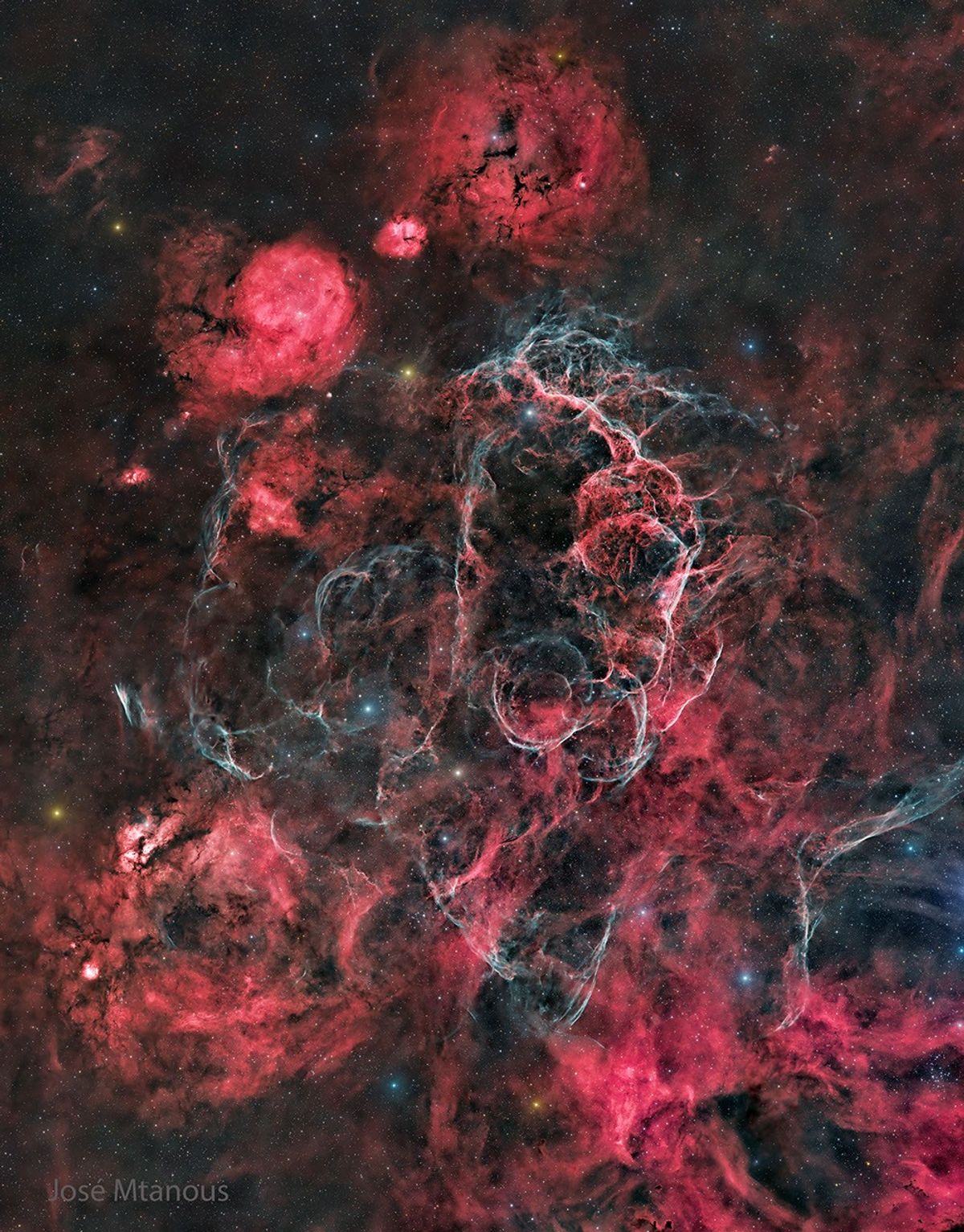
Selected image source ↗ APOD published June 2, 2026. Credit: José Mtanous. A publication-date match, not a photo taken on your date. Independent of NASA.
Read the original APOD for the astronomer’s explanation and full image credits. Its text is preserved in the archive as published.
The explosion is over, but the consequences continue. About twelve thousand years ago, a relatively normal star in the constellation Vela suddenly exploded, creating a strange point of light briefly visible to humans living near the beginning of recorded history. The outer layers of the star crashed into the interstellar medium, driving a shock wave that is still visible today. The featured image, taken piecemeal over 60 hours from the Khomas Region of Namibia, captures some of that filamentary and gigantic shock in visible light, with details highlighted by hydrogen (red) and oxygen (blue) emissions. As gas flies away from the detonated star, it decays and reacts with the interstellar medium, producing light in many different colors and energy bands. Remaining at the center of the Vela Supernova Remnant is a pulsar, a star as dense as nuclear matter that spins around more than ten times in a single second. Explore the Universe: Random APOD Generator
Image credit: José Mtanous
Updated · APOD entries through