June 11, 2026
June 11, 2026
A little universe, just for you
Free PNG · 1080 × 1350 · No account needed
Image rights and credit requirements apply when sharing or reusing imagery.
Your celebration date stays the same. Each image keeps its actual publication date.
Selected image source ↗ APOD published June 11, 2026. Credit: Data acquisition: Sy Ming Wong; Processing: Guangyan Gao Text: Cecilia Chirenti (NASA GSFC, UMCP, CRESST II). A publication-date match, not a photo taken on your date. Independent of NASA.
Read the original APOD for the astronomer’s explanation and full image credits. Its text is preserved in the archive as published.
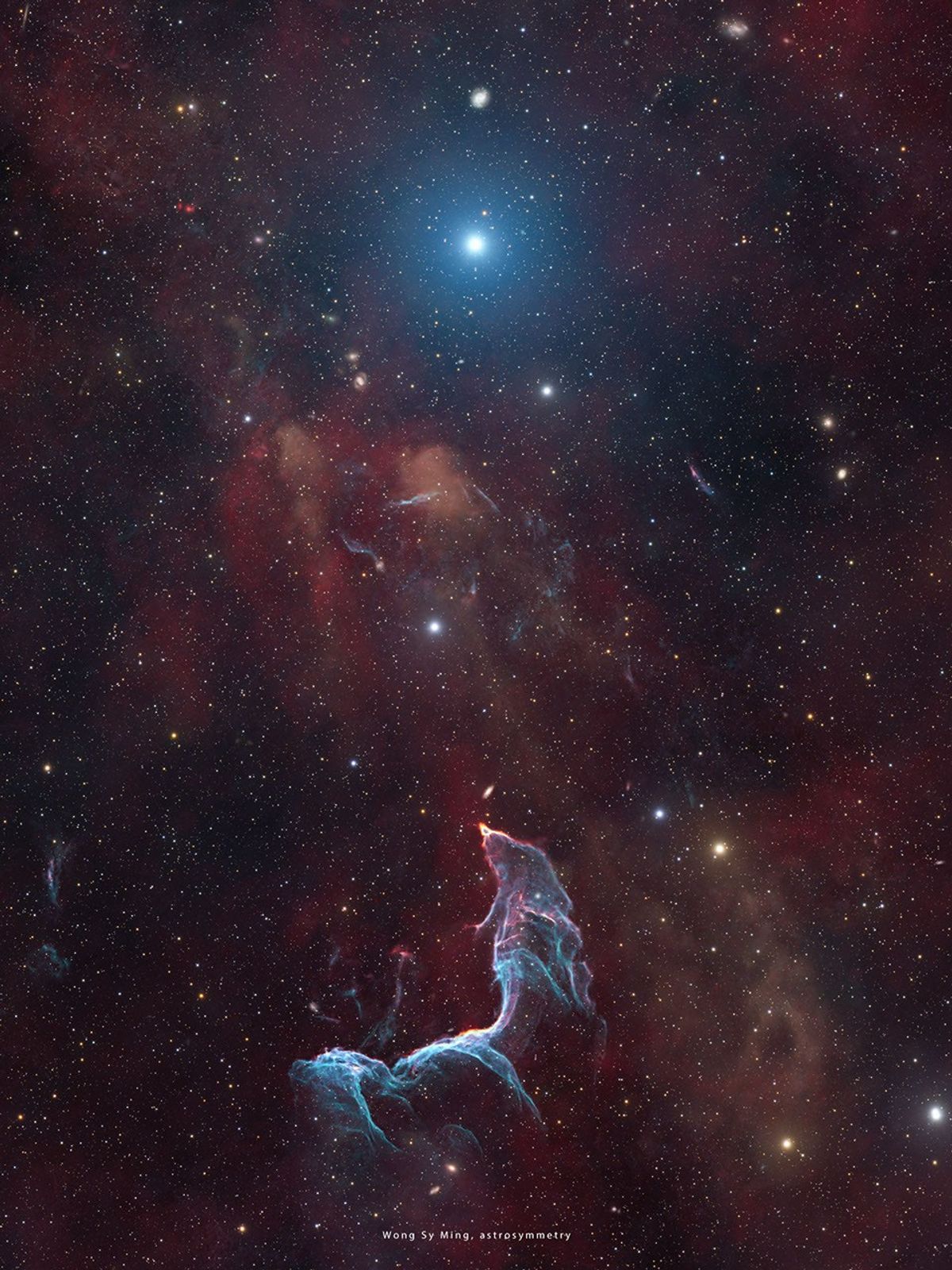
Could the Little Mermaid turn into stardust instead of seafoam? It would seem so in this beautiful nebula. The featured image shows the Mermaid Nebula, also known as the Betta Fish Nebula, which is part of the G296.5+10.0 Supernova Remnant. The blue color visible here originates from doubly ionized oxygen (OIII), while the deep red is emitted by hydrogen gas. Estimated to be located a few thousand light-years away and about 10,000 years old, this nebula was formed when a massive star exploded as a supernova. It left behind a peculiar pulsar, a young radio-quiet neutron star that spins around about twice every second. The bright stars shown in the image are unassociated with the nebula. The pulsar can be detected in the X-rays but it does not have a confirmed detection in the optical (visible light) so far. As a result, the pulsar itself is not visible in this image.
Image credit: Data acquisition: Sy Ming Wong; Processing: Guangyan Gao Text: Cecilia Chirenti (NASA GSFC, UMCP, CRESST II)
Updated · APOD entries through