July 2, 2026
July 2, 2026
A little universe, just for you
Free PNG · 1080 × 1350 · No account needed
Image rights and credit requirements apply when sharing or reusing imagery.
Your celebration date stays the same. Each image keeps its actual publication date.
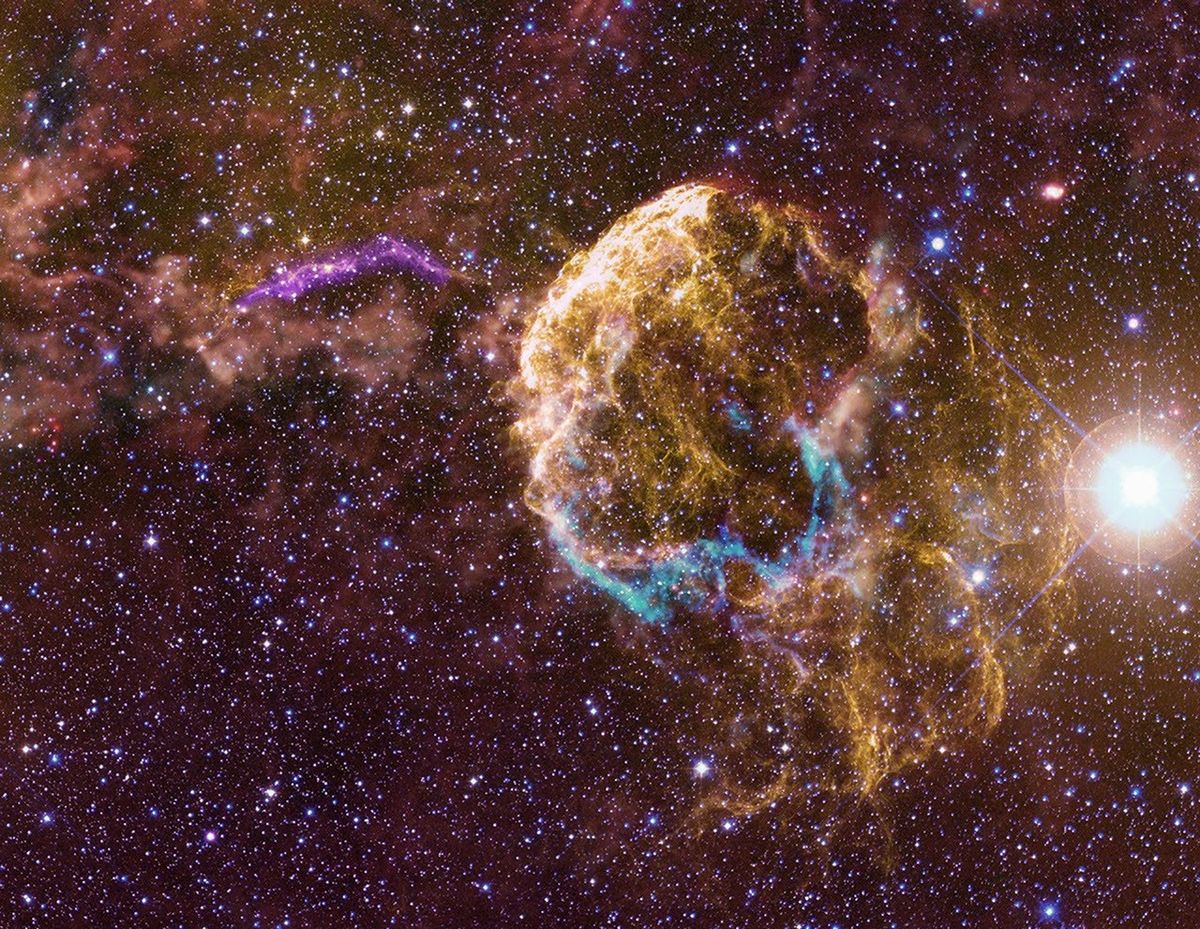
Selected image source ↗ APOD published July 2, 2026. Full image credits are on the original APOD entry below. A publication-date match, not a photo taken on your date. Independent of NASA.
Read the original APOD for the astronomer’s explanation and full image credits. Its text is preserved in the archive as published.
What happens when one of the stars in a binary goes supernova? This image combines visible (yellow), ultraviolet (purple) and infrared light (cyan, red and orange) to show two supernova remnants and their surrounding environment, about 6,000 light-years away. The younger one is the well-known Jellyfish Nebula in the center (mostly in yellow). If we could see it by eye, it would appear larger than the full moon in the sky. The filament shown in purple is part of an older, overlapping supernova remnant, G189.6+3.3. A new study used data from NASA's Fermi Gamma-ray Space Telescope to piece together their story. Astronomers believe that there were two stars in a binary system, then the first one exploded as a supernova, kicking away its companion, which also exploded as a supernova tens of thousands of years later, creating the superimposed supernova remnants we see today. The bright star on the right is actually a triple star system named Propus.
Updated · APOD entries through