January 9, 2026
January 9, 2026
A little universe, just for you
Free PNG · 1080 × 1350 · No account needed
Image rights and credit requirements apply when sharing or reusing imagery.
Your celebration date stays the same. Each image keeps its actual publication date.
Selected image source ↗ APOD published January 9, 2026. Credit: ice halos. A publication-date match, not a photo taken on your date. Independent of NASA.
Read the original APOD for the astronomer’s explanation and full image credits. Its text is preserved in the archive as published.
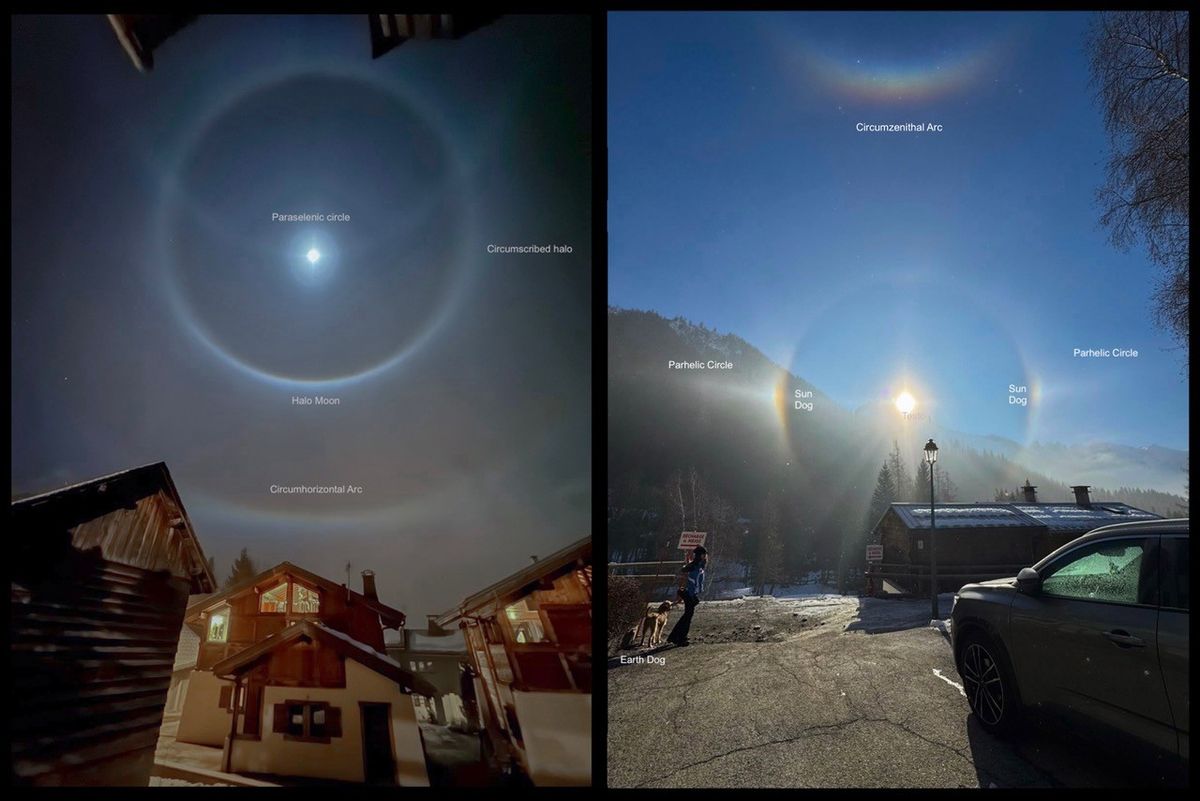
Both Moon and Sun create beautiful ice halos in planet Earth's sky. In fact, the two brightest celestial beacons are each surrounded by a complex of ice halos in these photos of the sky above Chamonix-Mont-Blanc in France. The panels were recorded one night (left) and the following day at the end of December 2025. Similar ice halos appear in moonlight and sunlight because they are all formed through the geometry of flat, hexagonal ice crystals. The ice crystals reflect and refract light as they flutter in the cold atmosphere above the mountain resort. In the pictures both Moon and Sun are surrounded by a more commonly seen 22 degree circular halo. Bright and sometimes colorful patches at the intersections of the 22 degree circular halos with the indicated parselenic and parhelic arcs are also known as Moon dogs and Sun dogs. (Editor's note: Annotations updated by Marcella Pace)
Image credit: ice halos
Updated · APOD entries through