January 27, 2026
January 27, 2026
A little universe, just for you
Free PNG · 1080 × 1350 · No account needed
Image rights and credit requirements apply when sharing or reusing imagery.
Your celebration date stays the same. Each image keeps its actual publication date.
Selected image source ↗ APOD published January 27, 2026. Credit: Włodzimierz Bubak; Text: Ogetay Kayali (MTU). A publication-date match, not a photo taken on your date. Independent of NASA.
Read the original APOD for the astronomer’s explanation and full image credits. Its text is preserved in the archive as published.
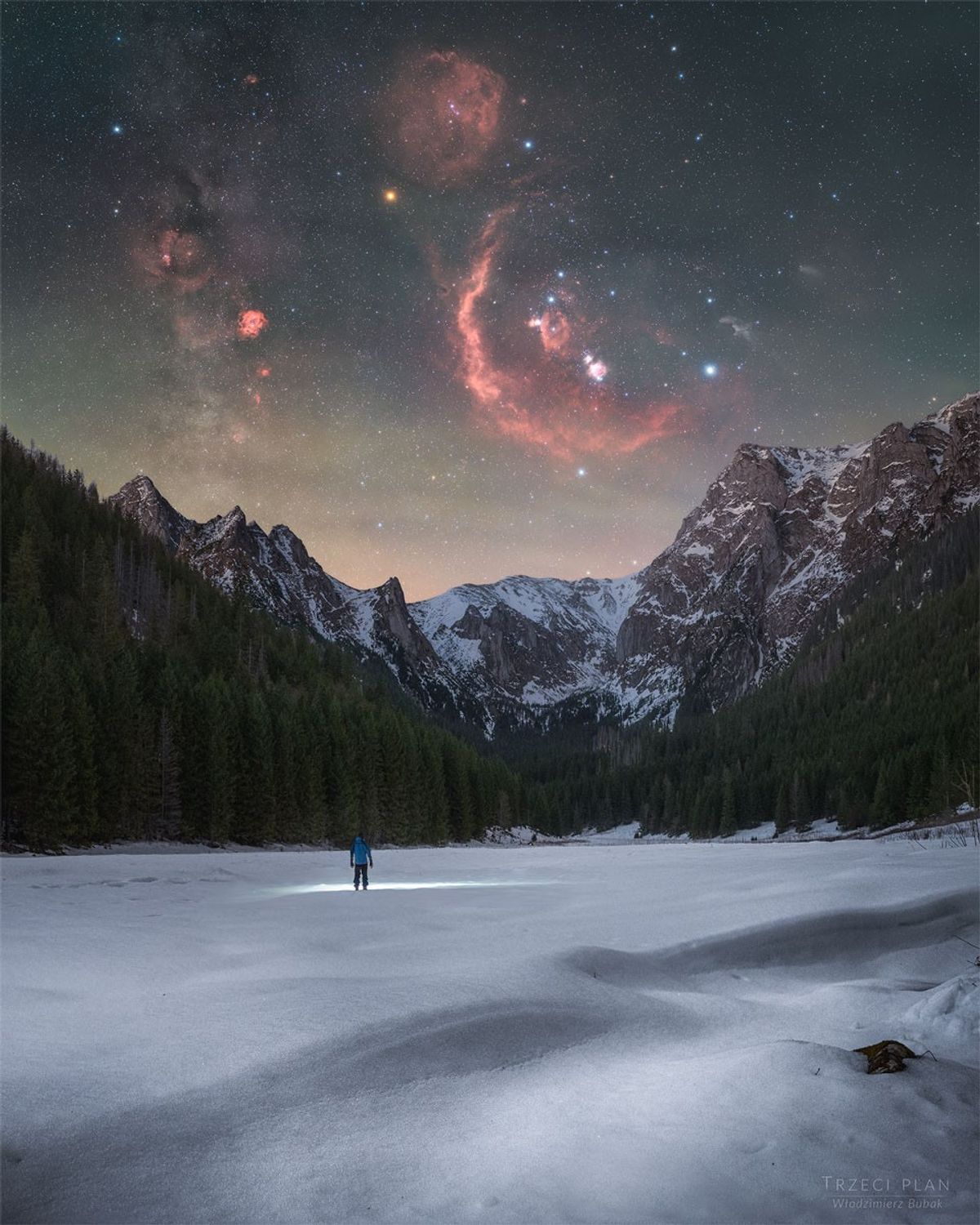
Rising over a frozen valley in the Tatra Mountains, the familiar stars and nebulas of Orion dominate this wide-field nightscape. The featured deep photo was taken in southern Poland's highest mountain range last month, where dark skies and alpine terrain combined to reveal both Earth's rugged beauty and the structure of our galaxy. Above the snowy mountains, Orion's bright belt stars anchor a region of glowing interstellar clouds. The Great Orion Nebula, a vast stellar nursery visible even to the unaided eye, shines near the center of the scene. Surrounding it is the enormous arc of Barnard's Loop, a faint shell of ionized hydrogen gas spanning much of the constellation. To the left, the round Rosette Nebula glows softly, while the grayish Witch Head Nebula hovers to the right, illuminated by nearby starlight. Near the top, the orange supergiant Betelgeuse marks the hunter's shoulder.
Image credit: Włodzimierz Bubak; Text: Ogetay Kayali (MTU)
Updated · APOD entries through