January 22, 2026
January 22, 2026
A little universe, just for you
Free PNG · 1080 × 1350 · No account needed
Image rights and credit requirements apply when sharing or reusing imagery.
Your celebration date stays the same. Each image keeps its actual publication date.
Selected image source ↗ APOD published January 22, 2026. Credit: Chris Fellows. A publication-date match, not a photo taken on your date. Independent of NASA.
Read the original APOD for the astronomer’s explanation and full image credits. Its text is preserved in the archive as published.
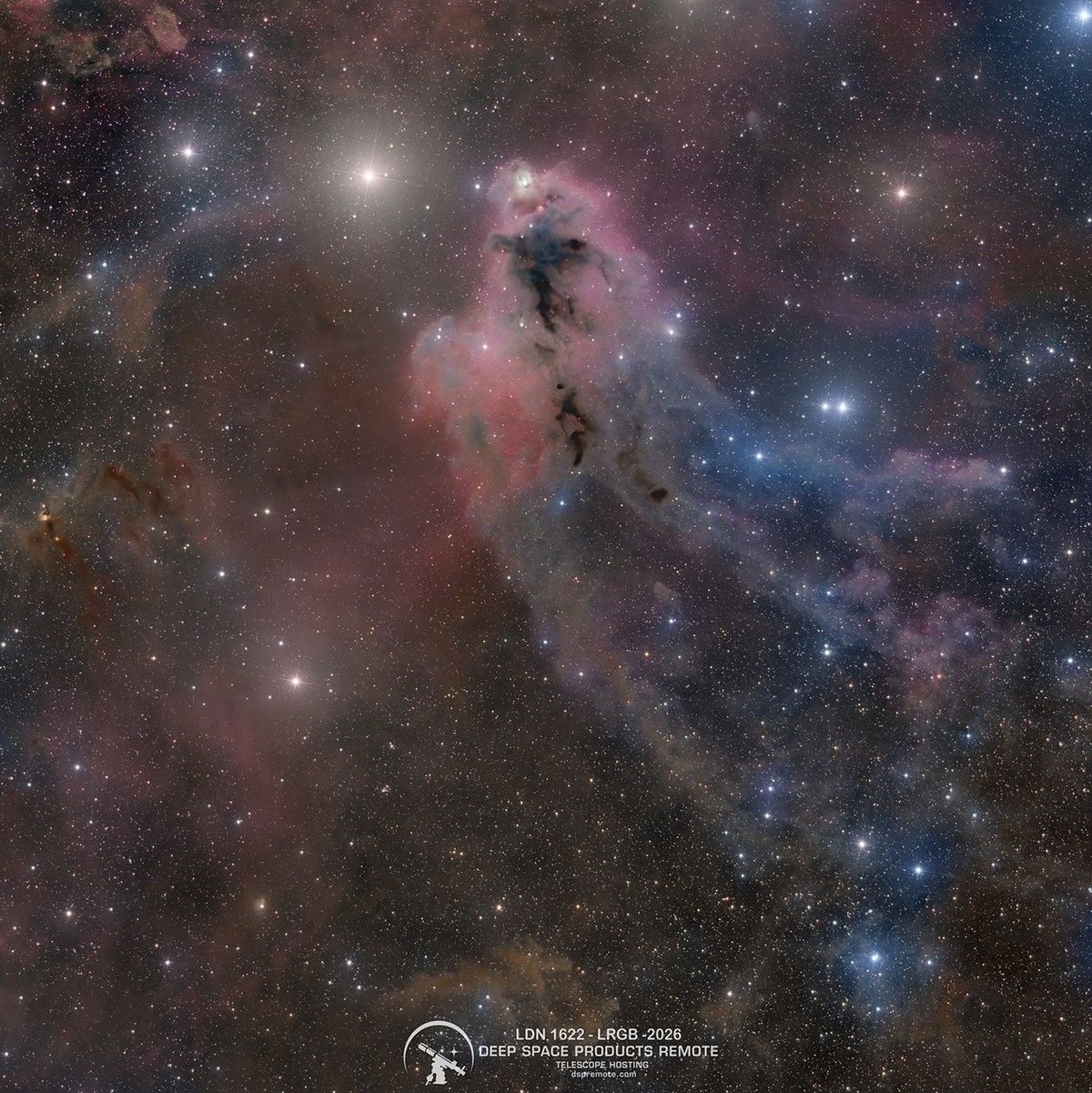
The silhouette of an intriguing dark nebula inhabits this cosmic scene. Lynds' Dark Nebula (LDN) 1622 appears against a faint background of glowing hydrogen gas only visible in long telescopic exposures of the region. In contrast, a brighter reflection nebula, vdB 62, is more easily seen just above the dusty dark nebula. LDN 1622 lies near the plane of our Milky Way Galaxy, close on the sky to Barnard's Loop, a large cloud surrounding the rich complex of emission nebulae found in the Belt and Sword of Orion. With swept-back outlines, the obscuring dust of LDN 1622 is thought to lie at a similar distance, perhaps 1,500 light-years away. At that distance, this 3 degree wide field of view would span about 100 light-years. Young stars do lie hidden within the dark expanse and have been revealed in Spitzer Space telescope infrared images. Still, the foreboding visual appearance of LDN 1622 inspires its popular name, the Boogeyman Nebula.
Image credit: Chris Fellows
Updated · APOD entries through