January 19, 2026
January 19, 2026
A little universe, just for you
Free PNG · 1080 × 1350 · No account needed
Image rights and credit requirements apply when sharing or reusing imagery.
Your celebration date stays the same. Each image keeps its actual publication date.
Selected image source ↗ APOD published January 19, 2026. Full image credits are on the original APOD entry below. A publication-date match, not a photo taken on your date. Independent of NASA.
Read the original APOD for the astronomer’s explanation and full image credits. Its text is preserved in the archive as published.
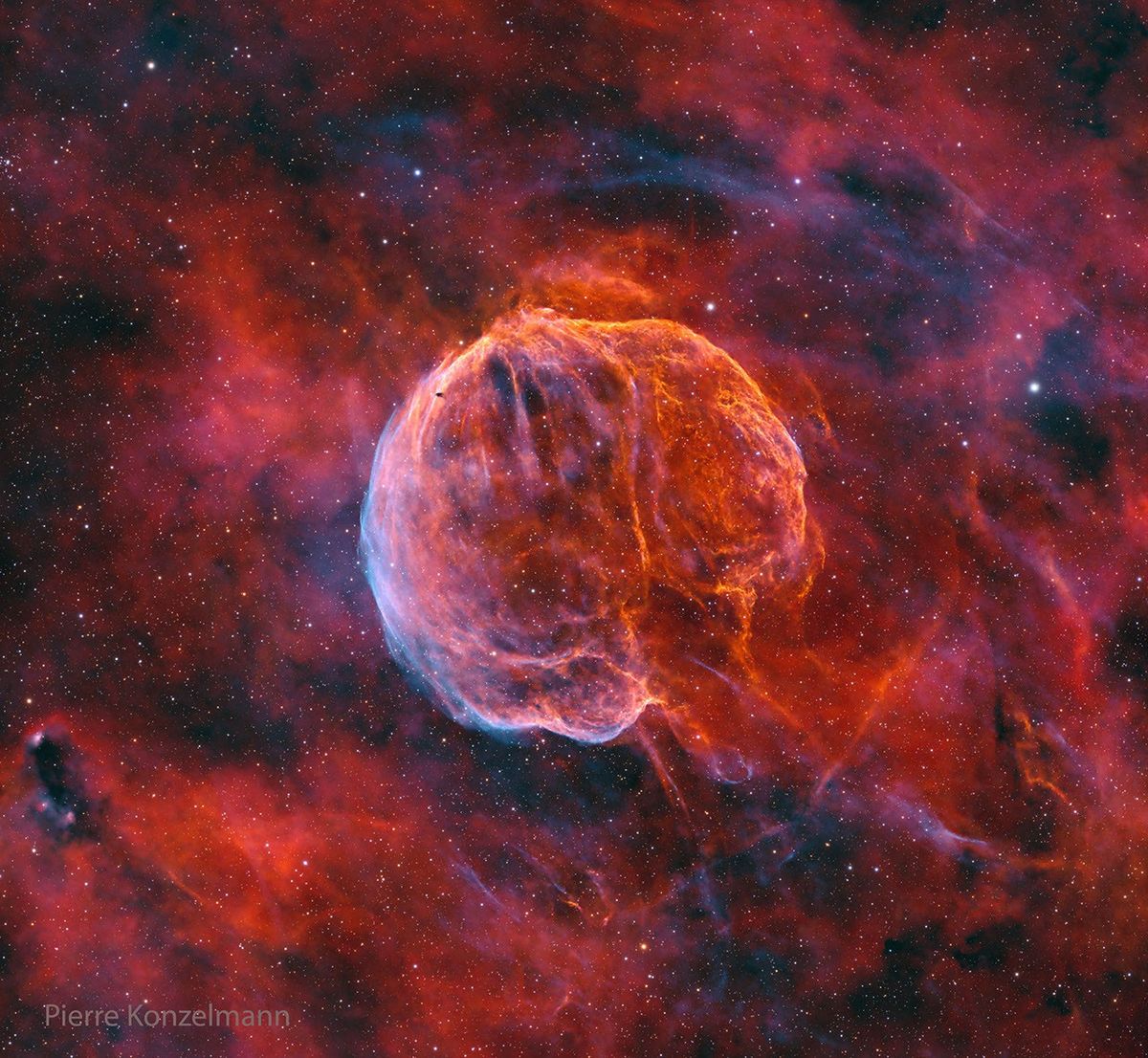
What powers this unusual nebula? CTB 1 is the expanding gas shell that was left when a massive star toward the constellation of Cassiopeia exploded about 10,000 years ago. The star likely detonated when it ran out of elements, near its core, that could create stabilizing pressure with nuclear fusion. The resulting supernova remnant, nicknamed the Medulla Nebula for its brain-like shape, still glows in visible light because of the heat generated by its collision with confining interstellar gas. Why the nebula also glows in X-ray light, though, remains a topic of research. One hypothesis holds that an energetic pulsar was created and powers the nebula with a fast outwardly moving wind. Following this lead, a pulsar was found in radio waves that appears to have been expelled by the supernova explosion at over 1000 kilometers per second. Although the Medulla Nebula appears as large as a full moon, it is so faint that it took 84-hours of exposure with a small telescope in Texas, USA, to create the featured image.
Updated · APOD entries through