February 6, 2026
February 6, 2026
A little universe, just for you
Free PNG · 1080 × 1350 · No account needed
Image rights and credit requirements apply when sharing or reusing imagery.
Your celebration date stays the same. Each image keeps its actual publication date.
Selected image source ↗ APOD published February 6, 2026. Full image credits are on the original APOD entry below. A publication-date match, not a photo taken on your date. Independent of NASA.
Read the original APOD for the astronomer’s explanation and full image credits. Its text is preserved in the archive as published.
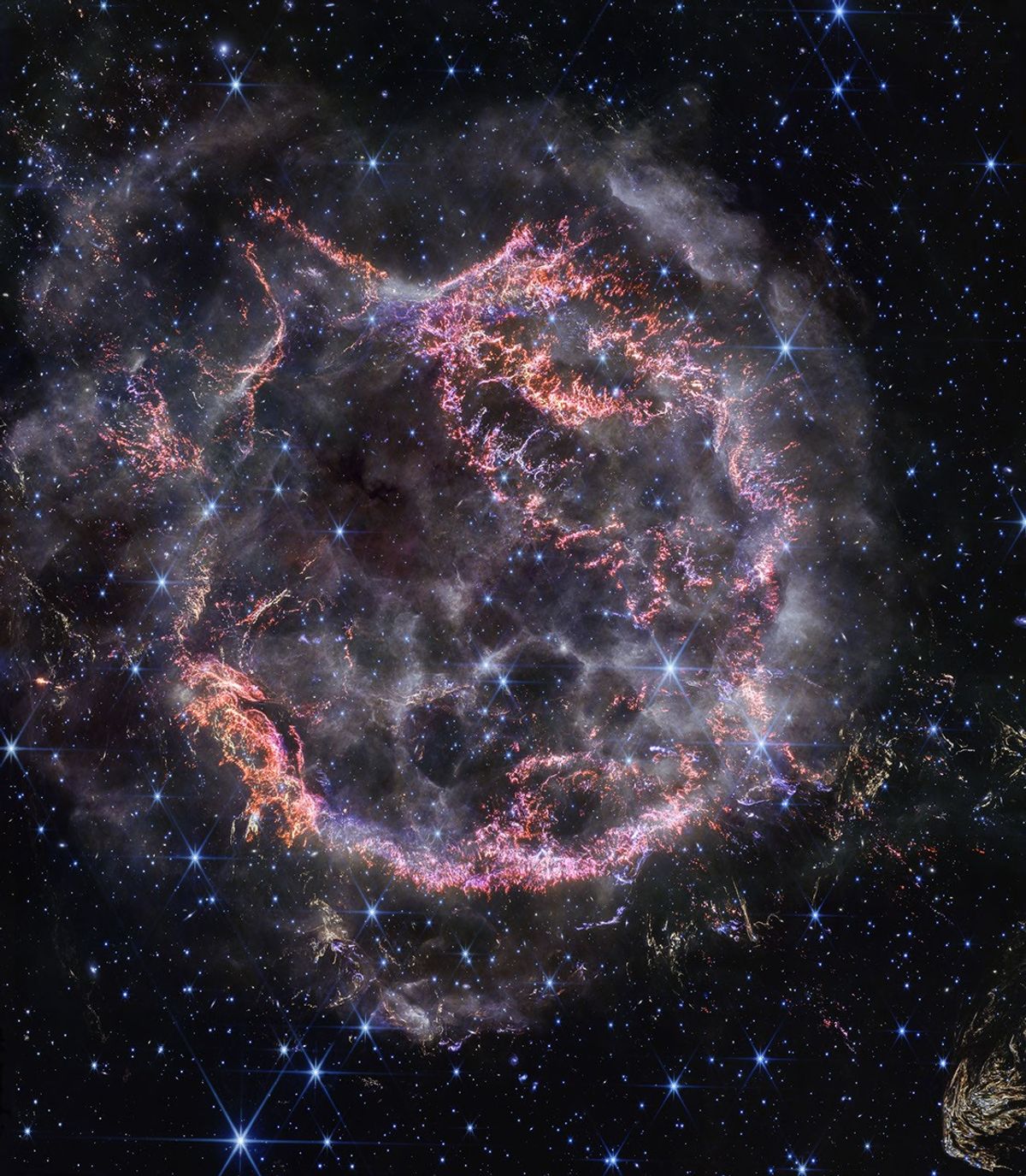
Massive stars in our Milky Way Galaxy live spectacular lives. Collapsing from vast cosmic clouds, their nuclear furnaces ignite and create heavy elements in their cores. After only a few million years for the most massive stars, the enriched material is blasted back into interstellar space where star formation can begin anew. The expanding debris cloud known as Cassiopeia A is an example of this final phase of the stellar life cycle. Light from the supernova explosion that created this remnant would have been first seen in planet Earth's sky about 350 years ago, although it took that light 11,000 years to reach us. This sharp NIRCam image from the James Webb Space Telescope shows the still-hot filaments and knots in the supernova remnant. The whitish, smoke-like outer shell of the expanding blast wave is about 20 light-years across. A series of light echoes from the massive star's cataclysmic explosion are also identified in Webb's detailed images of the surrounding interstellar medium.
Updated · APOD entries through