February 27, 2026
February 27, 2026
A little universe, just for you
Free PNG · 1080 × 1350 · No account needed
Image rights and credit requirements apply when sharing or reusing imagery.
Your celebration date stays the same. Each image keeps its actual publication date.
Selected image source ↗ APOD published February 27, 2026. Credit: Katelyn Beecroft. A publication-date match, not a photo taken on your date. Independent of NASA.
Read the original APOD for the astronomer’s explanation and full image credits. Its text is preserved in the archive as published.
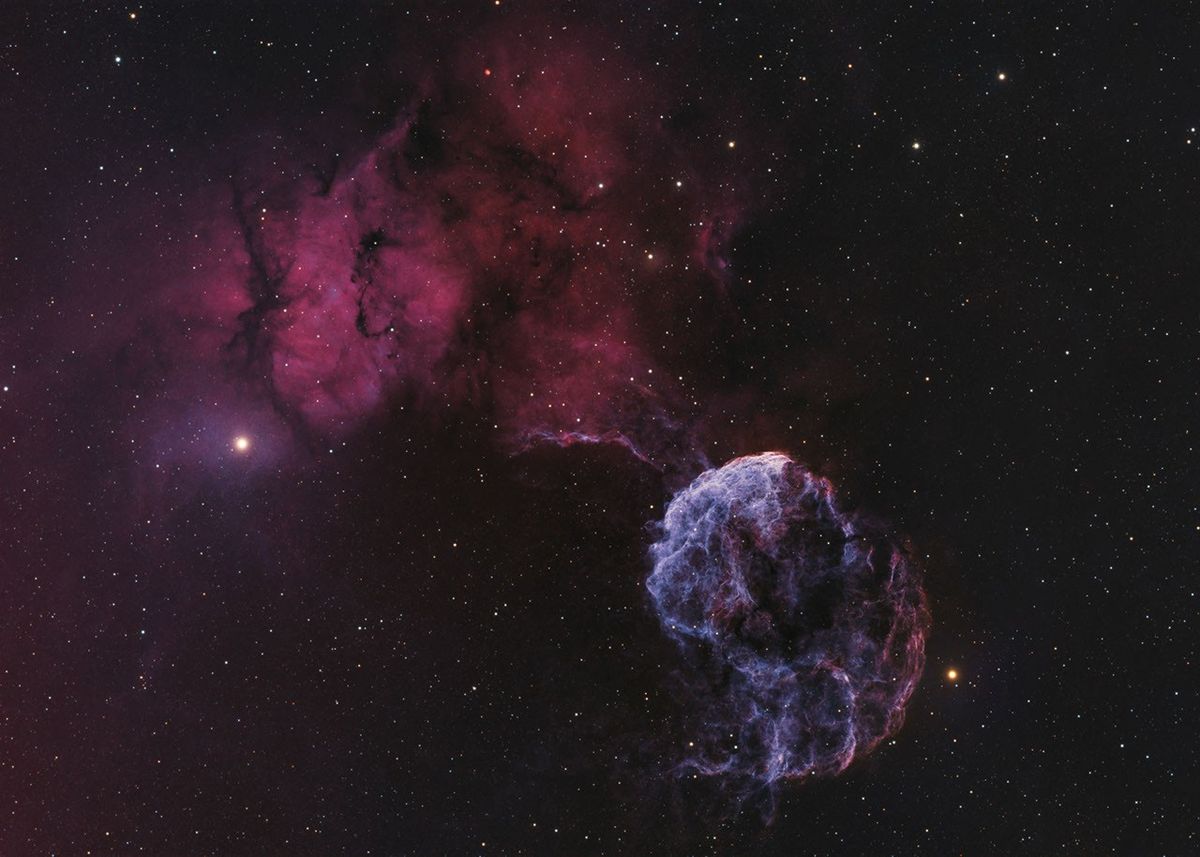
Normally faint and elusive, the Jellyfish Nebula is caught in this alluring telescopic field of view. Floating in the interstellar sea, the nebula is anchored right and left by two bright stars, Mu and Eta Geminorum, at the foot of the celestial twins. The Jellyfish Nebula itself is right of center, seen as a brighter arcing ridge of emission with dangling tentacles. In fact, this cosmic jellyfish is part of bubble-shaped supernova remnant IC 443, the expanding debris cloud from a massive star that exploded. Light from the explosion first reached planet Earth over 30,000 years ago. Like its cousin in astrophysical waters the Crab Nebula supernova remnant, the Jellyfish Nebula is known to harbor a neutron star, the ultradense remnant of the collapsed stellar core. An emission nebula cataloged as Sharpless 249 fills the field at the upper left. The Jellyfish Nebula is about 5,000 light-years away. At that distance, this image would be about 300 light-years across.
Image credit: Katelyn Beecroft
Updated · APOD entries through