February 26, 2026
February 26, 2026
A little universe, just for you
Free PNG · 1080 × 1350 · No account needed
Image rights and credit requirements apply when sharing or reusing imagery.
Your celebration date stays the same. Each image keeps its actual publication date.
Selected image source ↗ APOD published February 26, 2026. Full image credits are on the original APOD entry below. A publication-date match, not a photo taken on your date. Independent of NASA.
Read the original APOD for the astronomer’s explanation and full image credits. Its text is preserved in the archive as published.
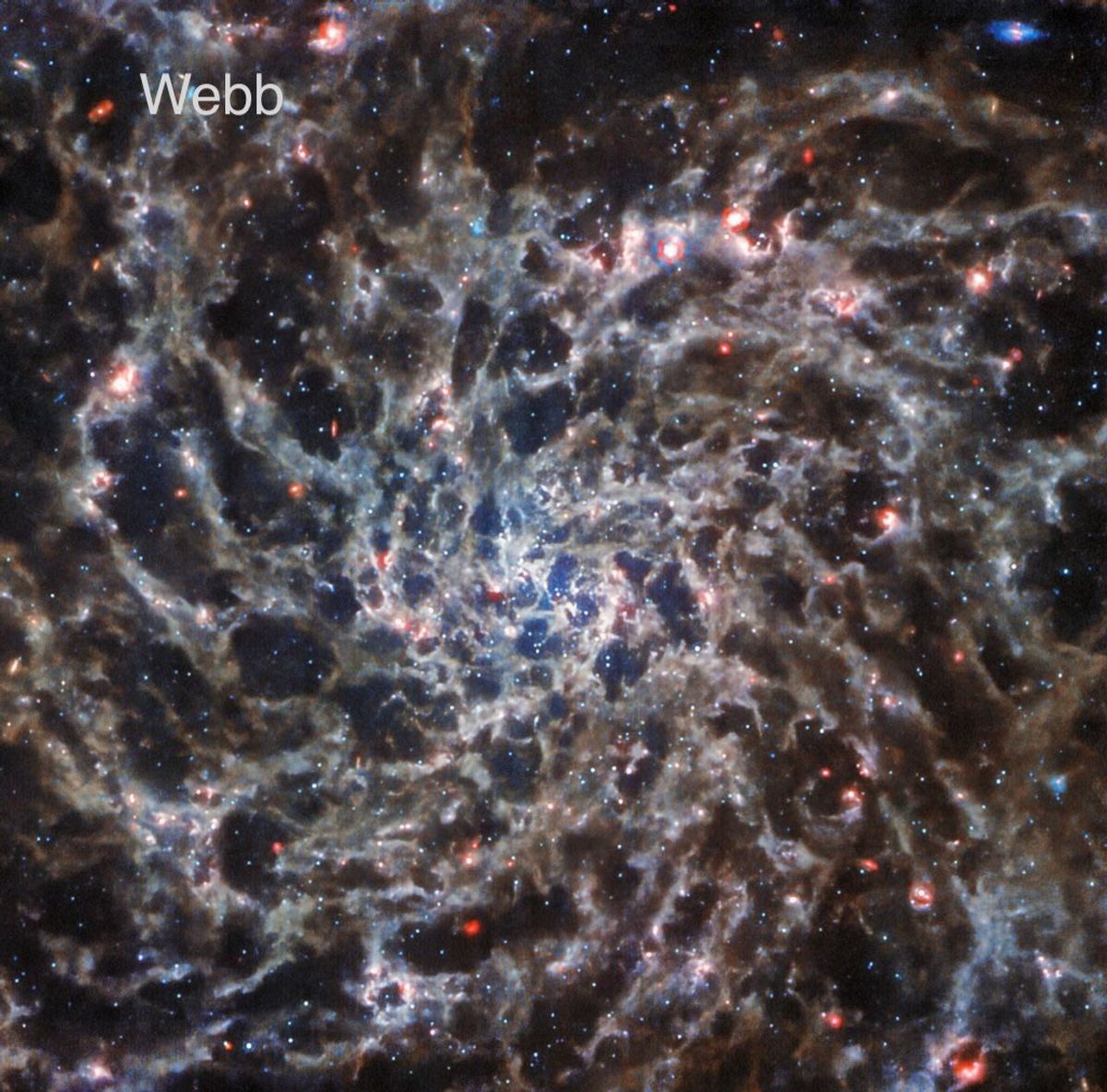
What does the universe look like through infrared goggles? Our eyes can only see visible light, but astronomers want to see more. Today’s APOD shows spiral galaxy IC 5332 as seen by two NASA telescopes: Webb in mid-infrared and Hubble in ultraviolet and visible light. To toggle between the two space-based views just slide your cursor over the image (or follow this link). The Hubble image highlights the spiral arms of the galaxy separated by dark regions, whereas the Webb image reveals a finer, more tangled structure. Interstellar dust scatters and absorbs light from the stars in the galaxy, causing the dark dust lanes in the Hubble image, and then emits heat in infrared light, so dust glows in this Webb image. The Mid-InfraRed Instrument on Webb needs to operate at a chilling temperature of -266ºC (or - 447ºF), otherwise it would detect infrared radiation from the telescope itself. Combining these observations, astronomers connect the “small scale” of gas and stars to the truly large scale of galactic structure and evolution.
Updated · APOD entries through