February 19, 2026
February 19, 2026
A little universe, just for you
Free PNG · 1080 × 1350 · No account needed
Image rights and credit requirements apply when sharing or reusing imagery.
Your celebration date stays the same. Each image keeps its actual publication date.
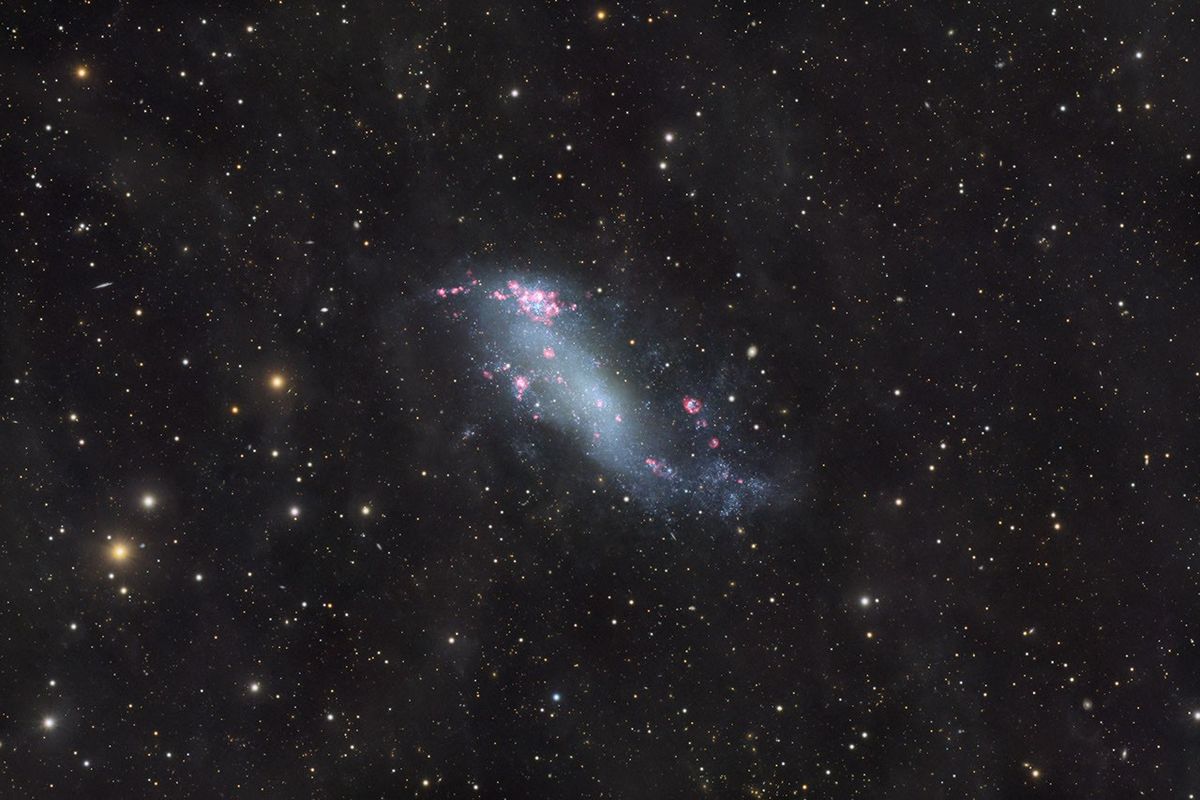
Selected image source ↗ APOD published February 19, 2026. Credit: Dane Vetter. A publication-date match, not a photo taken on your date. Independent of NASA.
Read the original APOD for the astronomer’s explanation and full image credits. Its text is preserved in the archive as published.
Grand spiral galaxies often seem to get all the glory, flaunting their young, bright, blue star clusters in beautiful, symmetric spiral arms. But small, irregular galaxies form stars too. In fact, dwarf galaxy IC 2574 shows clear evidence of intense star forming activity in its telltale reddish regions of glowing hydrogen gas. Just as in spiral galaxies, the turbulent star-forming regions in IC 2574 are churned by stellar winds and supernova explosions spewing material into the galaxy's interstellar medium and triggering further star formation. A mere 12 million light-years distant, IC 2574 is part of the M81 group of galaxies, seen toward the northern constellation Ursa Major. Also known as Coddington's Nebula, the faint but intriguing island universe is about 50,000 light-years across, discovered by American astronomer Edwin Coddington in 1898.
Image credit: Dane Vetter
Updated · APOD entries through