February 18, 2026
February 18, 2026
A little universe, just for you
Free PNG · 1080 × 1350 · No account needed
Image rights and credit requirements apply when sharing or reusing imagery.
Your celebration date stays the same. Each image keeps its actual publication date.
Selected image source ↗ APOD published February 18, 2026. Credit: Piotr Czerski. A publication-date match, not a photo taken on your date. Independent of NASA.
Read the original APOD for the astronomer’s explanation and full image credits. Its text is preserved in the archive as published.
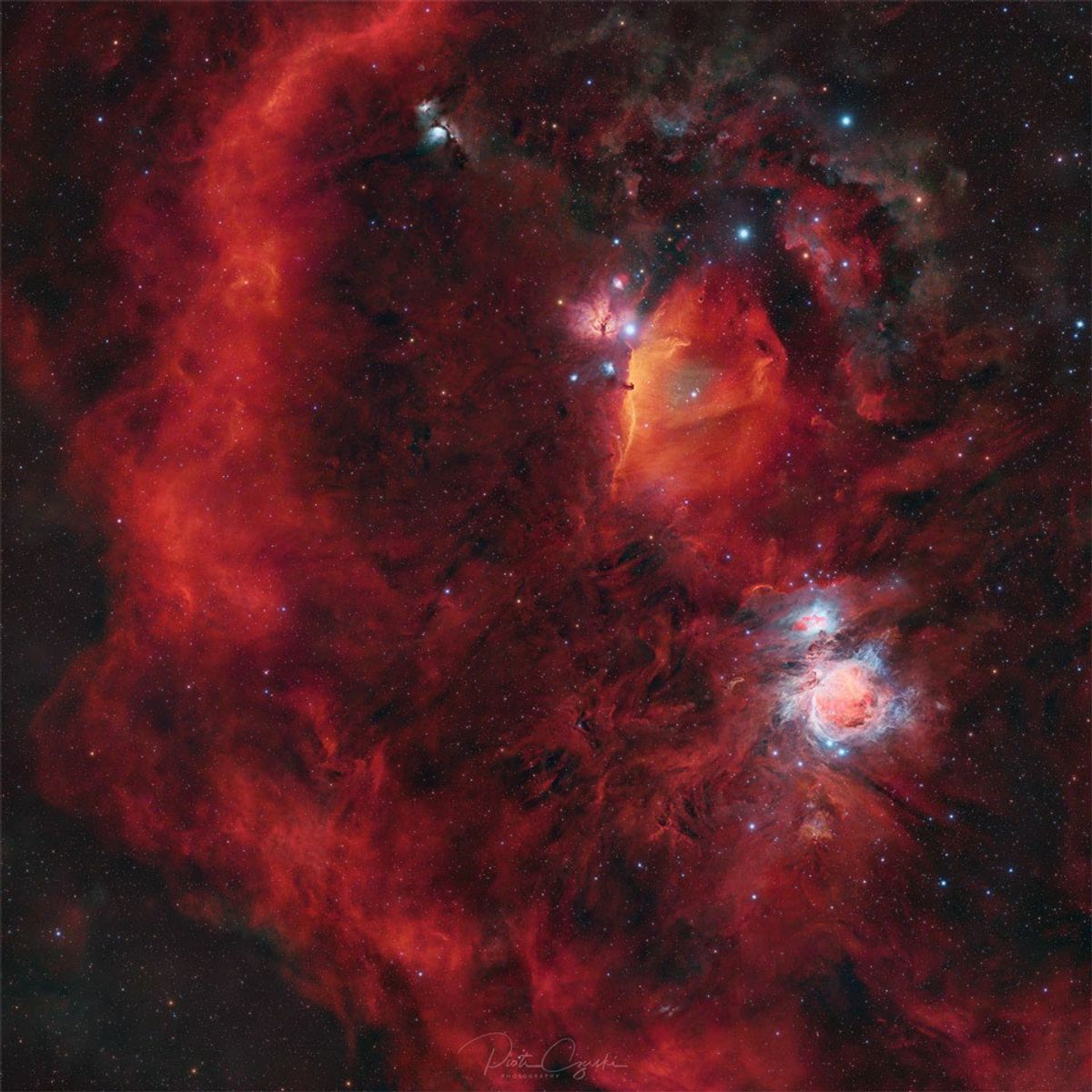
Cradled in red-glowing hydrogen gas, stars are being born in Orion. These stellar nurseries lie at the edge of the giant Orion molecular cloud complex, some 1,500 light-years away. This detailed view spans about 12 degrees across the center of the well-known constellation, with the Great Orion Nebula, the closest large star-forming region, visible toward the lower right. The deep mosaic also includes, near the top center, the Flame Nebula and the Horsehead Nebula. Image data acquired with a hydrogen-alpha filter adds other remarkable features to this wide-angle cosmic vista: pervasive tendrils of energized atomic hydrogen gas and portions of the surrounding Barnard's Loop. While the Orion Nebula and many stars in Orion are easy to see with the unaided eye, emission from the extensive interstellar gas is faint and much harder to record, even in telescopic views of the nebula-rich complex. Sky Surprise: What picture did APOD feature on your birthday? (after 1995)
Image credit: Piotr Czerski
Updated · APOD entries through