February 12, 2026
February 12, 2026
A little universe, just for you
Free PNG · 1080 × 1350 · No account needed
Image rights and credit requirements apply when sharing or reusing imagery.
Your celebration date stays the same. Each image keeps its actual publication date.
Selected image source ↗ APOD published February 12, 2026. Credit: Olaf Filzinger. A publication-date match, not a photo taken on your date. Independent of NASA.
Read the original APOD for the astronomer’s explanation and full image credits. Its text is preserved in the archive as published.
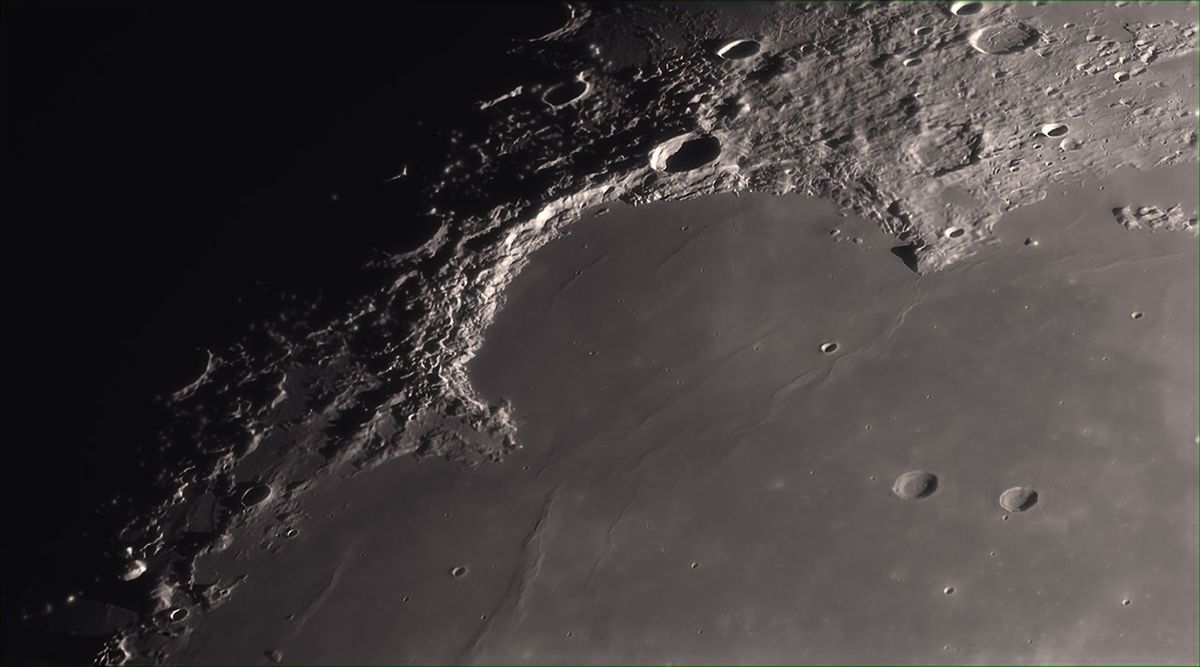
Dark, smooth regions that cover the Moon's familiar face are called by Latin names for oceans and seas. That naming convention is historical, though it may seem a little ironic to denizens of the space age who recognize the Moon as a mostly dry and airless world, and the smooth, dark areas as lava-flooded impact basins. For example, this telescopic lunar vista, looks over the expanse of the northwestern Mare Imbrium, or Sea of Rains and into the Sinus Iridum, the Bay of Rainbows. Ringed by the Jura Mountains (montes), the bay is about 250 kilometers across. Seen after local sunrise, the mountains form part of the Sinus Iridum impact crater wall. Their rugged sunlit arc is bounded at the top by Cape (promontorium) Laplace reaching nearly 3,000 meters above the bay's surface. At the bottom of the arc is Cape Heraclides, depicted by Giovanni Cassini in his 1679 telescope-based drawings mapping the moon, as a moon maiden seen in profile with long, flowing hair.
Image credit: Olaf Filzinger
Updated · APOD entries through