February 11, 2026
February 11, 2026
A little universe, just for you
Free PNG · 1080 × 1350 · No account needed
Image rights and credit requirements apply when sharing or reusing imagery.
Your celebration date stays the same. Each image keeps its actual publication date.
Selected image source ↗ APOD published February 11, 2026. Full image credits are on the original APOD entry below. A publication-date match, not a photo taken on your date. Independent of NASA.
Read the original APOD for the astronomer’s explanation and full image credits. Its text is preserved in the archive as published.
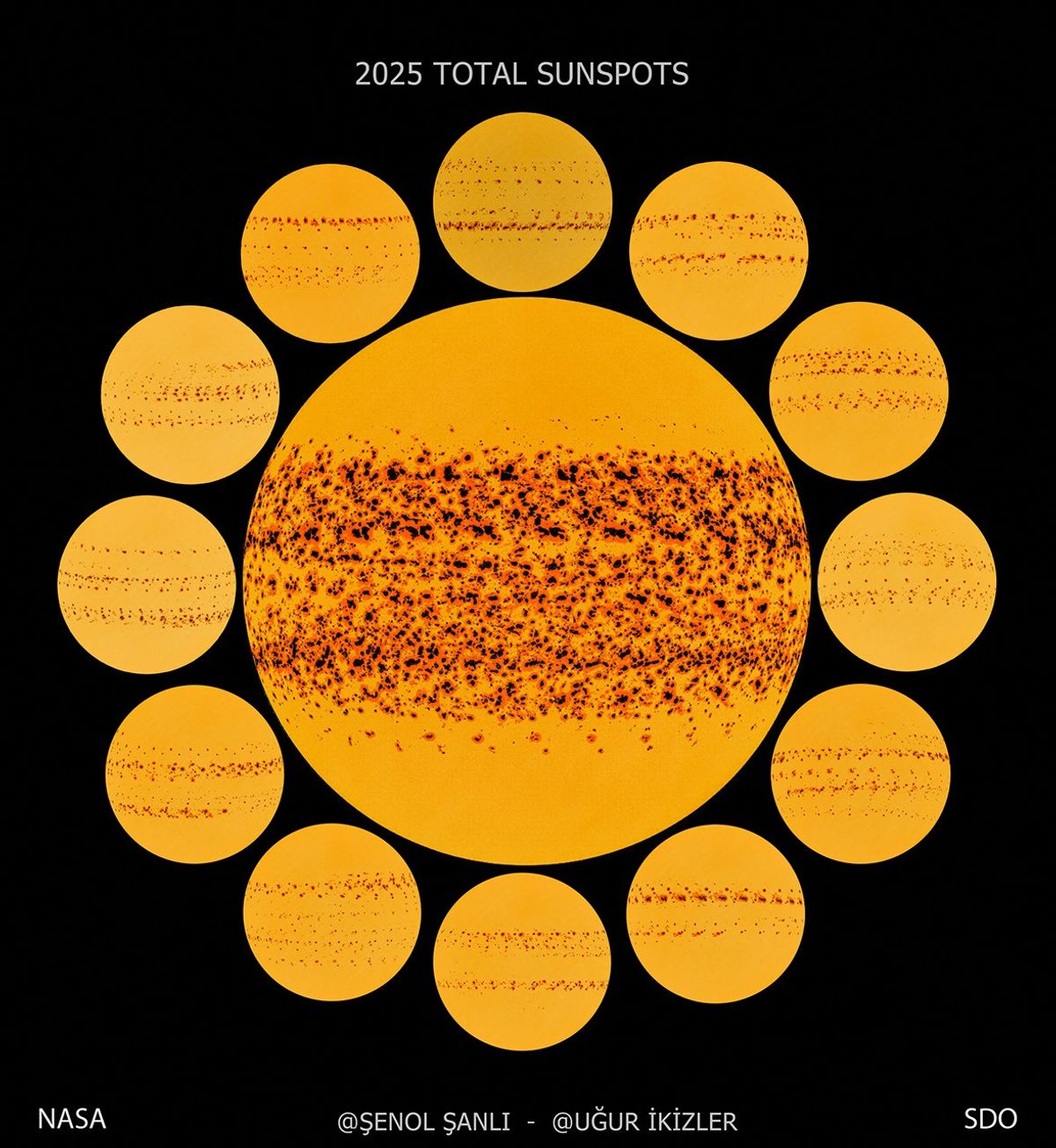
How many sunspots can you see? The central image shows the many sunspots that occurred in 2025, month by month around the circle, and all together in the grand central image. Each sunspot is magnetically cooled and so appears dark -- and can last from days to months. Although the featured images originated from NASA's Solar Dynamics Observatory, sunspots can be easily seen with a small telescope or binoculars equipped with a solar filter. Very large sunspot groups like recent AR 4366 can even be seen with eclipse glasses. Sunspots are still counted by eye, but the total number is not considered exact because they frequently change and break up. Last year, 2025, coincided with a solar maximum, the period of most intense magnetic activity during its 11-year solar cycle. Our Sun remains unpredictable in many ways, including when it ejects solar flares that will impact the Earth, and how active the next solar cycle will be.
Updated · APOD entries through