December 5, 2025
December 5, 2025
A little universe, just for you
Free PNG · 1080 × 1350 · No account needed
Image rights and credit requirements apply when sharing or reusing imagery.
Your celebration date stays the same. Each image keeps its actual publication date.
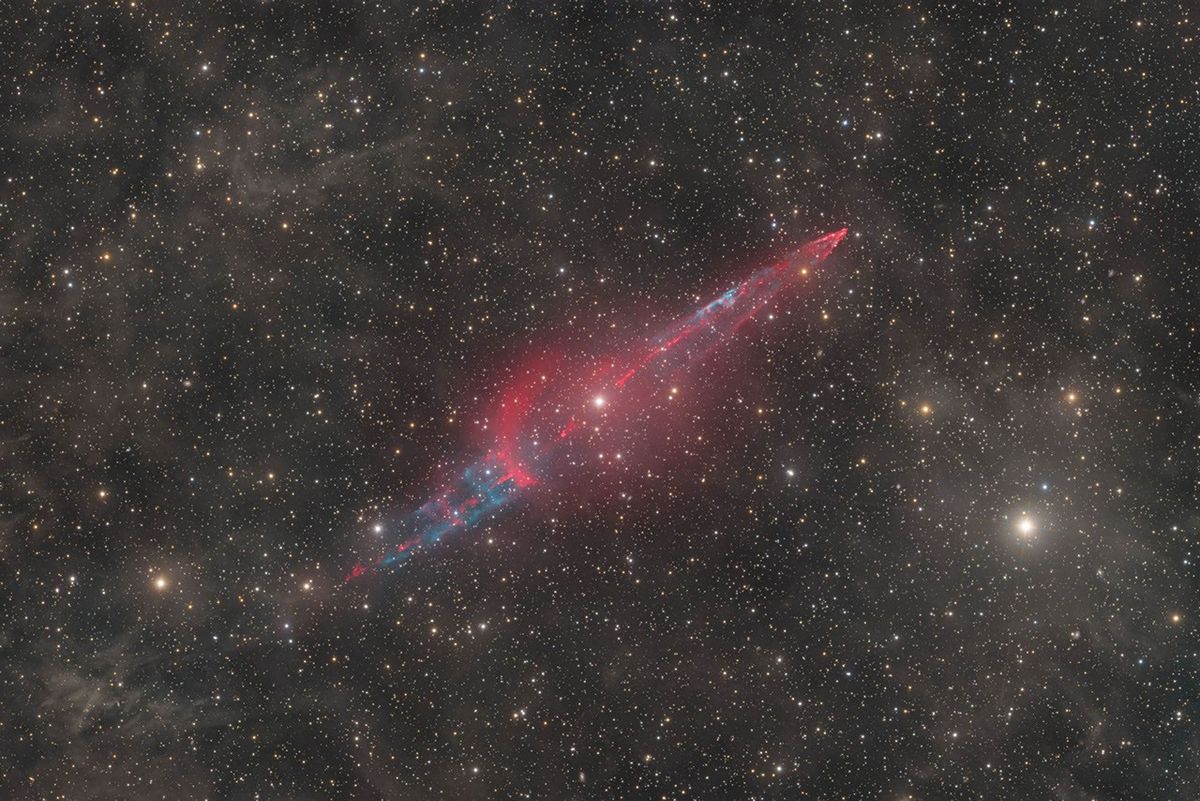
Selected image source ↗ APOD published December 5, 2025. Credit: Tim Schaeffer. A publication-date match, not a photo taken on your date. Independent of NASA.
Read the original APOD for the astronomer’s explanation and full image credits. Its text is preserved in the archive as published.
Blasting outward from variable star KX Andromedae, these stunning bipolar jets are 19 light-years long. Recently discovered, they are revealed in unprecedented detail in this deep telescopic image centered on KX And and composed from over 692 hours of combined image data. In fact, KX And is spectroscopically found to be an interacting binary star system consisting of a bright, hot B-type star with a swollen cool giant star as its co-orbiting, close companion. The stellar material from the cool giant star is likely being transferred to the hot B-type star through an accretion disk, with spectacular symmetric jets driven outward perpendicular to the disk itself. The known distance to KX And of 2,500 light-years, angular size of the jets, and estimated inclination of the accretion disk lead to the size estimate for each jet of an astonishing 19 light-years. Free APOD Lecture in Phoenix: Wednesday, December 10 at 7 pm
Image credit: Tim Schaeffer
Updated · APOD entries through