December 2, 2025
December 2, 2025
A little universe, just for you
Free PNG · 1080 × 1350 · No account needed
Image rights and credit requirements apply when sharing or reusing imagery.
Your celebration date stays the same. Each image keeps its actual publication date.
Selected image source ↗ APOD published December 2, 2025. Full image credits are on the original APOD entry below. A publication-date match, not a photo taken on your date. Independent of NASA.
Behind the original result
Read the original APOD for the astronomer’s explanation and full image credits. Its text is preserved in the archive as published.
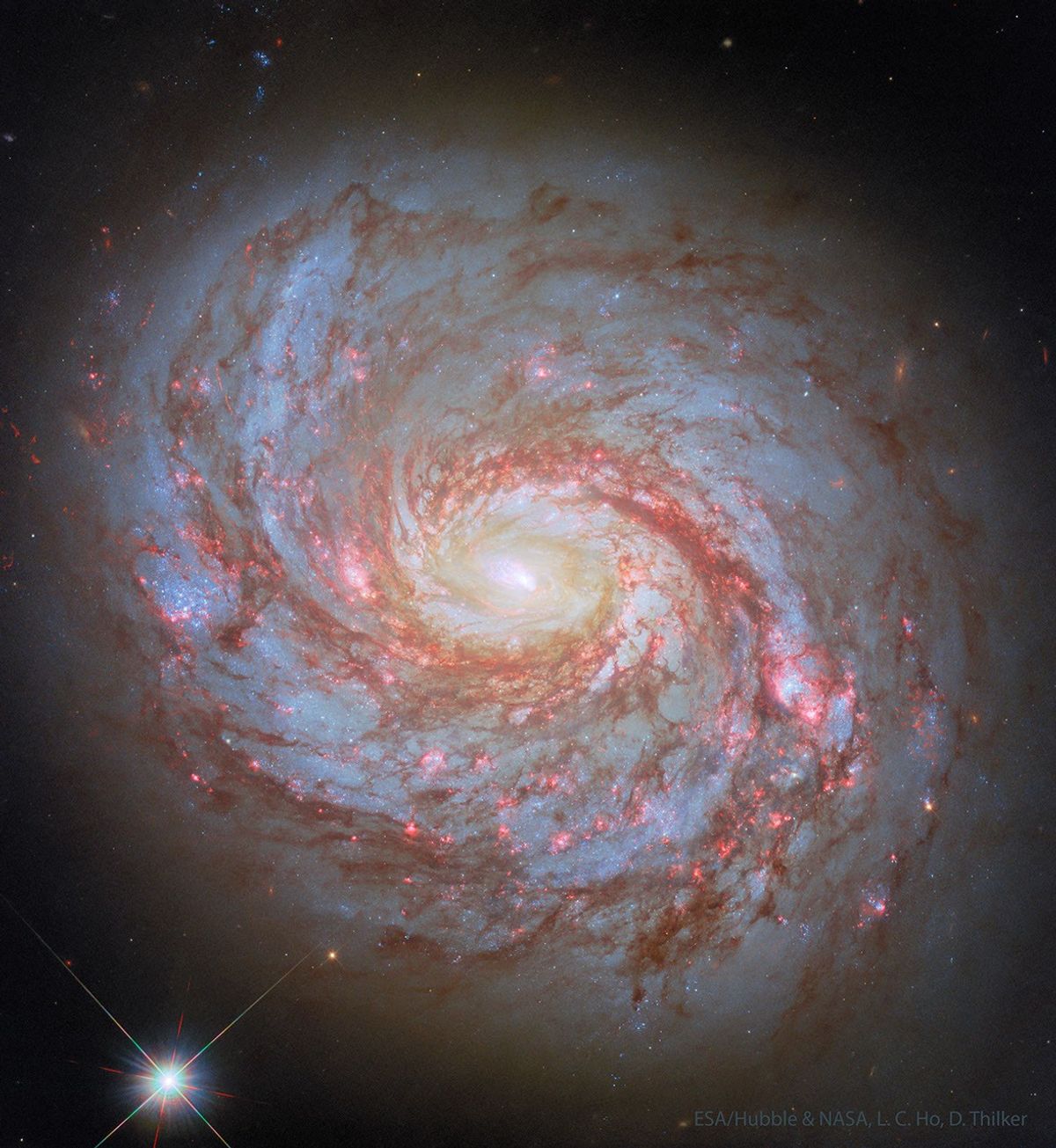
What's happening in the center of nearby spiral galaxy M77? The face-on galaxy lies a mere 47 million light-years away toward the constellation of the Sea Monster (Cetus). At that estimated distance, this gorgeous island universe is about 100 thousand light-years across. Also known as NGC 1068, its compact and very bright core is well studied by astronomers exploring the mysteries of supermassive black holes in active Seyfert galaxies. M77's active core glows bright at x-ray, ultraviolet, visible, infrared, and radio wavelengths. The featured sharp image of M77 was taken by the Hubble Space Telescope. The image shows details of the spiral's winding spiral arms as traced by obscuring red dust clouds and blue star clusters, all circling the galaxy's bright white luminous center. Free APOD Lecture in Phoenix: Wednesday, December 10 at 7 pm
Updated · APOD entries through