December 26, 2025
December 26, 2025
A little universe, just for you
Free PNG · 1080 × 1350 · No account needed
Image rights and credit requirements apply when sharing or reusing imagery.
Your celebration date stays the same. Each image keeps its actual publication date.
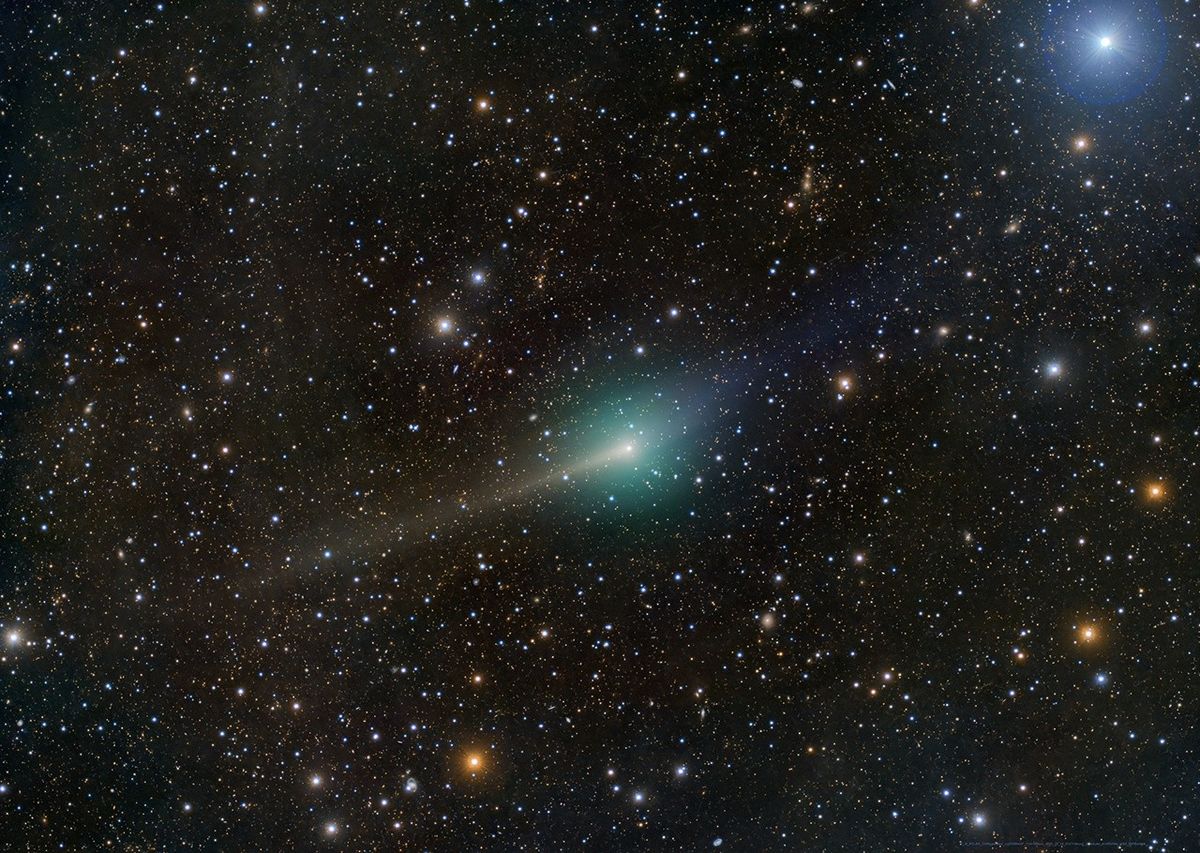
Selected image source ↗ APOD published December 26, 2025. Credit: Dan Bartlett. A publication-date match, not a photo taken on your date. Independent of NASA.
Read the original APOD for the astronomer’s explanation and full image credits. Its text is preserved in the archive as published.
Attention grabbing interstellar visitor 3I/ATLAS made its not-so-close flyby of our fair planet on December 19 at a distance of 1.8 astronomical units. That's about 900 light-seconds. This deep exposure captures the comet from another star system as it gently swept across a faint background of stars in the constellation Leo about 4 days earlier. Though faint, colors emphasized in the image data show off the comet's yellowish dust tail and bluish ion tail along with a greenish tinged coma. And even as it is scrutinized by arrays of telescopes and spacecraft from planet Earth, 3I/ATLAS is headed out of the Solar System. It's presently moving outward along a hyperbolic trajectory at about 64 kilometers per second relative to the Sun, too fast to be bound by the Sun's gravity.
Image credit: Dan Bartlett
Updated · APOD entries through