December 25, 2025
December 25, 2025
A little universe, just for you
Free PNG · 1080 × 1350 · No account needed
Image rights and credit requirements apply when sharing or reusing imagery.
Your celebration date stays the same. Each image keeps its actual publication date.
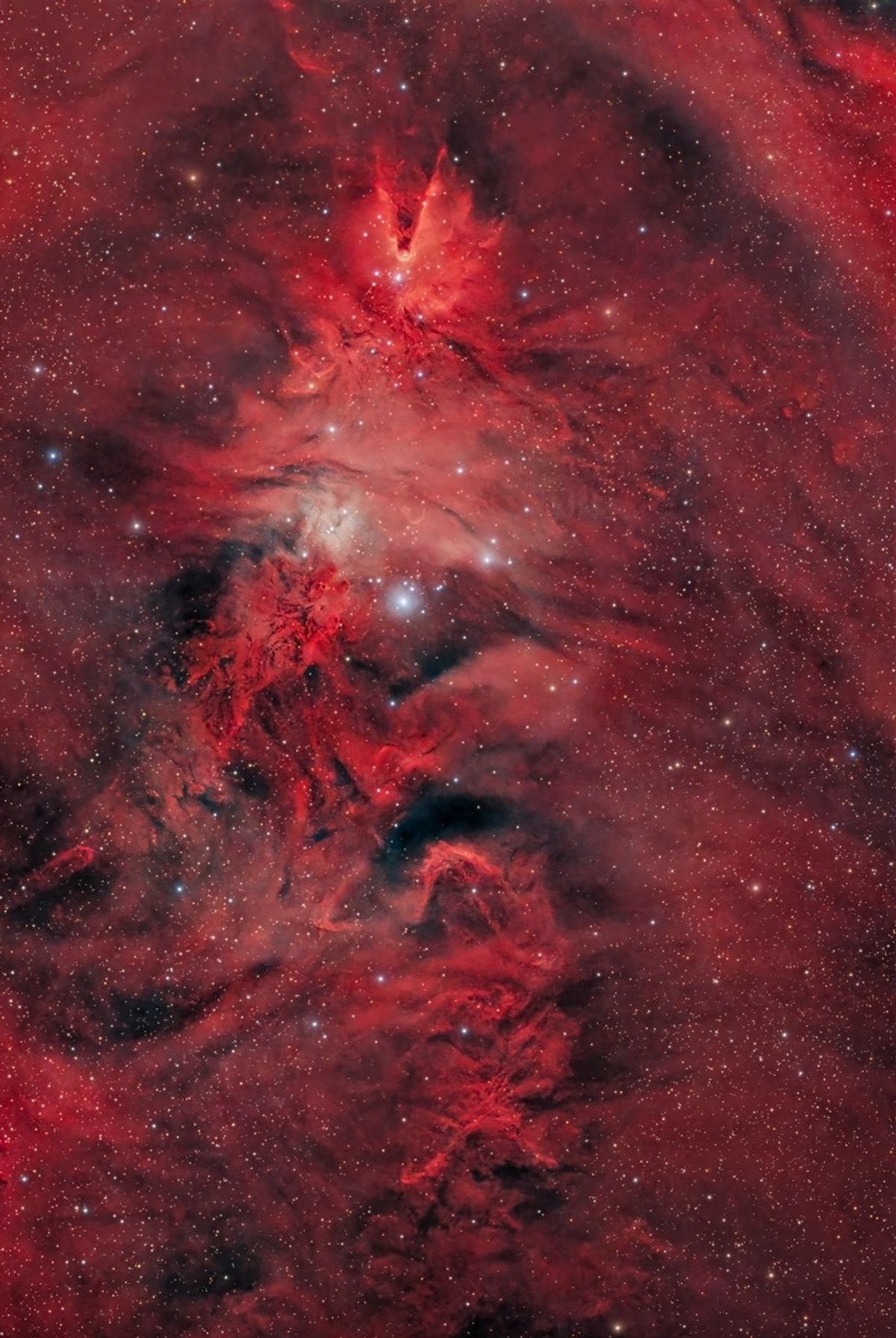
Selected image source ↗ APOD published December 25, 2025. Credit: Michael Kalika. A publication-date match, not a photo taken on your date. Independent of NASA.
Read the original APOD for the astronomer’s explanation and full image credits. Its text is preserved in the archive as published.
A star forming region cataloged as NGC 2264, this beautiful but complex arrangement of interstellar gas and dust is about 2,700 light-years distant in the faint but fanciful constellation Monoceros, the Unicorn. Seen toward the celestial equator and near the plane of our Milky Way galaxy, the seasonal skyscape mixes reddish emission nebulae excited by energetic light from newborn stars with dark interstellar dust clouds. Where the otherwise obscuring dust clouds lie close to the hot, young stars, they also reflect starlight, forming blue reflection nebulae. In fact, bright variable star S Monocerotis is immersed in a blue-tinted haze near center. Arrayed with a simple triangular outline above S Monocerotis, the stars of NGC 2264 are popularly known as the Christmas Tree star cluster. Carved by energetic starlight, the Cone Nebula sits upside down at the apex of this cosmic Christmas tree while the dusty, convoluted pelt of glowing gas and dust under the tree is called the Fox Fur Nebula. This rich telescopic frame spans about 1.5 degrees or 3 full moons on the sky top to bottom, covering nearly 80 light-years at the distance of NGC 2264.
Image credit: Michael Kalika
Updated · APOD entries through