December 1, 2025
December 1, 2025
A little universe, just for you
Free PNG · 1080 × 1350 · No account needed
Image rights and credit requirements apply when sharing or reusing imagery.
Your celebration date stays the same. Each image keeps its actual publication date.
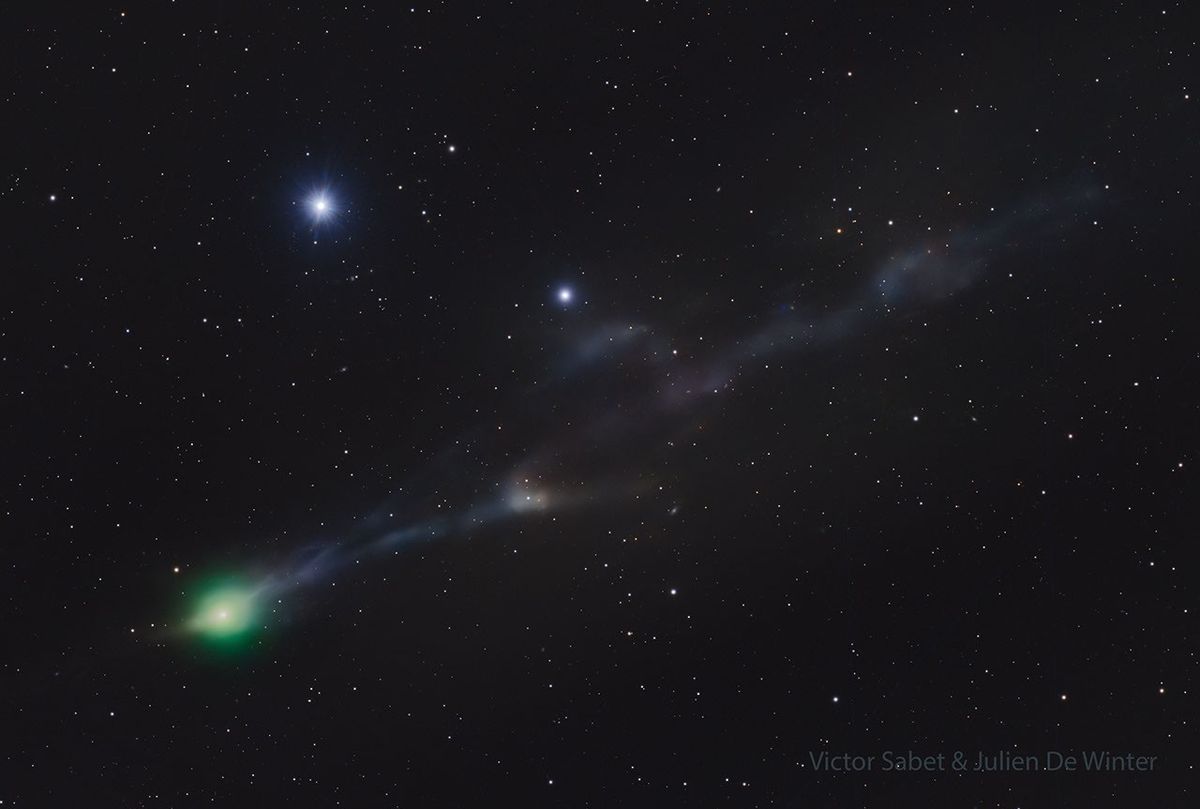
Selected image source ↗ APOD published December 1, 2025. Credit: Victor Sabet & Julien De Winter. A publication-date match, not a photo taken on your date. Independent of NASA.
Behind the original result
Read the original APOD for the astronomer’s explanation and full image credits. Its text is preserved in the archive as published.
How typical is our Solar System? Studying 3I/ATLAS, a comet just passing through, is providing clues. Confirmed previous interstellar visitors include an asteroid, a comet, a meteor, and a gas wind dominated by hydrogen and helium. Comet 3I/ATLAS appears relatively normal when compared to Solar System comets, therefore providing more evidence that our Solar System is a somewhat typical star system. For example, Comet 3I/ATLAS has a broadly similar chemical composition and ejected dust. The featured image was captured last week from Texas and shows a green coma, a wandering blue-tinted ion tail likely deflected by our Sun's wind, and a slight anti-tail, all typical cometary attributes. The comet, visible with a telescope, passed its closest to the Sun in late October and will pass its closest to the Earth in mid-December, after which it will return to interstellar space and never return. Explore the Universe: Random APOD Generator
Image credit: Victor Sabet & Julien De Winter
Updated · APOD entries through