December 18, 2025
December 18, 2025
A little universe, just for you
Free PNG · 1080 × 1350 · No account needed
Image rights and credit requirements apply when sharing or reusing imagery.
Your celebration date stays the same. Each image keeps its actual publication date.
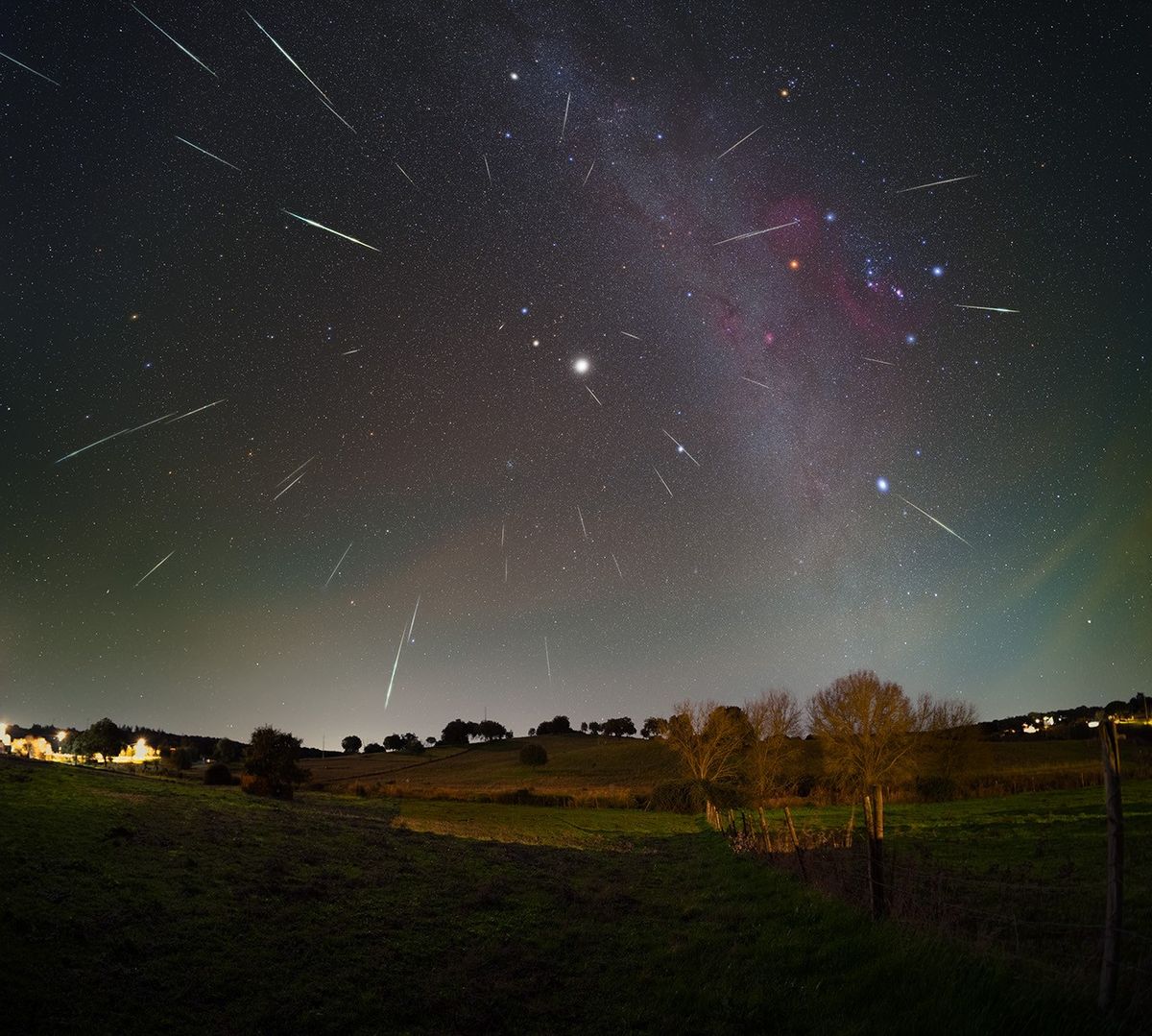
Selected image source ↗ APOD published December 18, 2025. Credit: David Cruz. A publication-date match, not a photo taken on your date. Independent of NASA.
Read the original APOD for the astronomer’s explanation and full image credits. Its text is preserved in the archive as published.
Jupiter, the Solar System's ruling gas giant, is the brightest celestial beacon at the center of this composite night skyscape. The scene was constructed by selecting the 40 exposures containing meteors from about 500 exposures made on the nights of December 13 and 14, near peak activity for this year's annual Geminid meteor shower. With each selected exposure registered in the night sky above Alentejo, Portugal, planet Earth, it does look like the meteors are streaming away from Jupiter. But the apparent radiant of the Geminid meteors is actually closer to bright star Castor, in the shower's eponymous constellation Gemini. In this frame that's just a little above and left of the Solar System's most massive planet. Still, the parent body of Geminid meteors is known to be rocky, near-Earth asteroid 3200 Phaethon. And the orbit of Phaethon itself is influenced by the gravitational attraction exerted by massive Jupiter, in concert with planets of the inner Solar System.
Image credit: David Cruz
Updated · APOD entries through