December 17, 2025
December 17, 2025
A little universe, just for you
Free PNG · 1080 × 1350 · No account needed
Image rights and credit requirements apply when sharing or reusing imagery.
Your celebration date stays the same. Each image keeps its actual publication date.
Selected image source ↗ APOD published December 17, 2025. Credit: Jeffrey Horne. A publication-date match, not a photo taken on your date. Independent of NASA.
Read the original APOD for the astronomer’s explanation and full image credits. Its text is preserved in the archive as published.
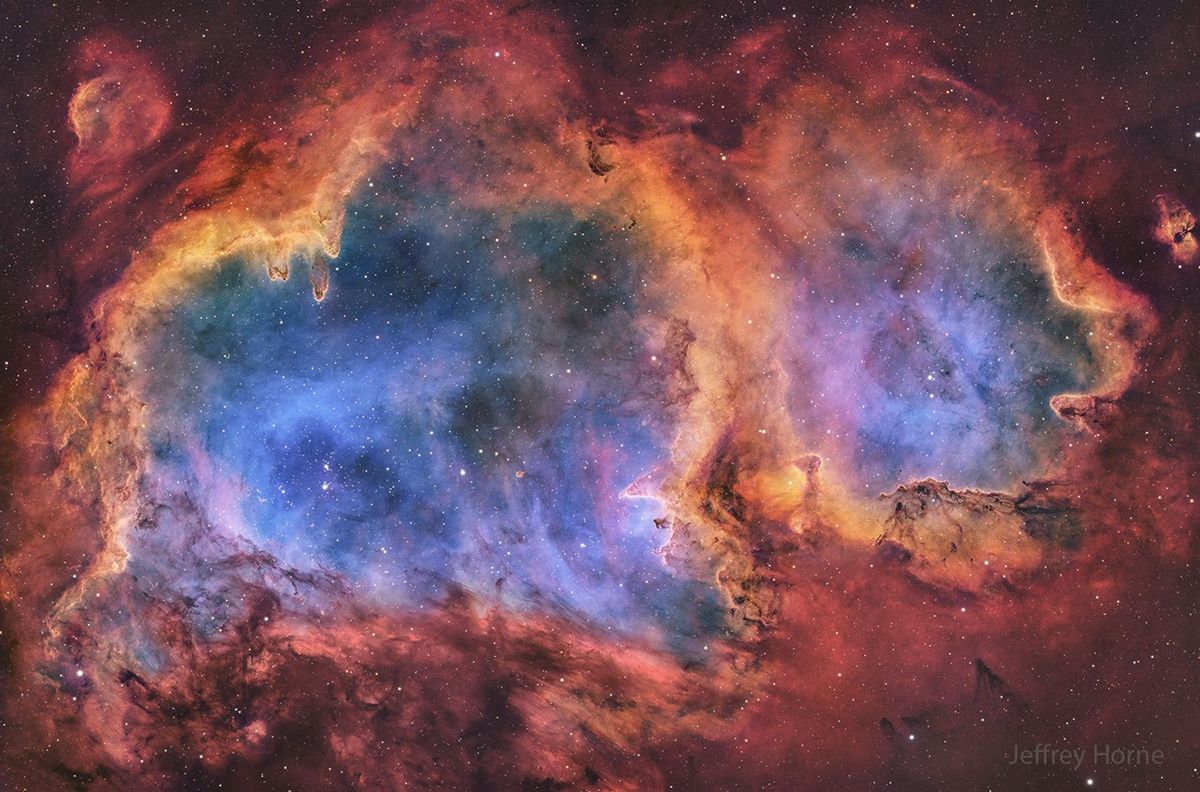
Stars are forming in the Soul of the Queen of Aethopia. More specifically, a large star forming region called the Soul Nebula can be found in the direction of the constellation Cassiopeia, whom Greek mythology credits as the vain wife of a King who long ago ruled lands surrounding the upper Nile river. Also known as Westerhout 5 (W5), the Soul Nebula houses several open clusters of stars, ridges and pillars darkened by cosmic dust, and huge evacuated bubbles formed by the winds of young massive stars. Located about 6,500 light years away, the Soul Nebula spans about 100 light years and is usually imaged next to its celestial neighbor the Heart Nebula (IC 1805). The featured image, taken from near Nashville, Tennessee, USA, is a composite of 234 hours of exposures made in different colors: red as emitted by hydrogen gas, yellow as emitted by sulfur, and blue as emitted by oxygen. Explore the Universe: Random APOD Generator
Image credit: Jeffrey Horne
Updated · APOD entries through