December 15, 2025
December 15, 2025
A little universe, just for you
Free PNG · 1080 × 1350 · No account needed
Image rights and credit requirements apply when sharing or reusing imagery.
Your celebration date stays the same. Each image keeps its actual publication date.
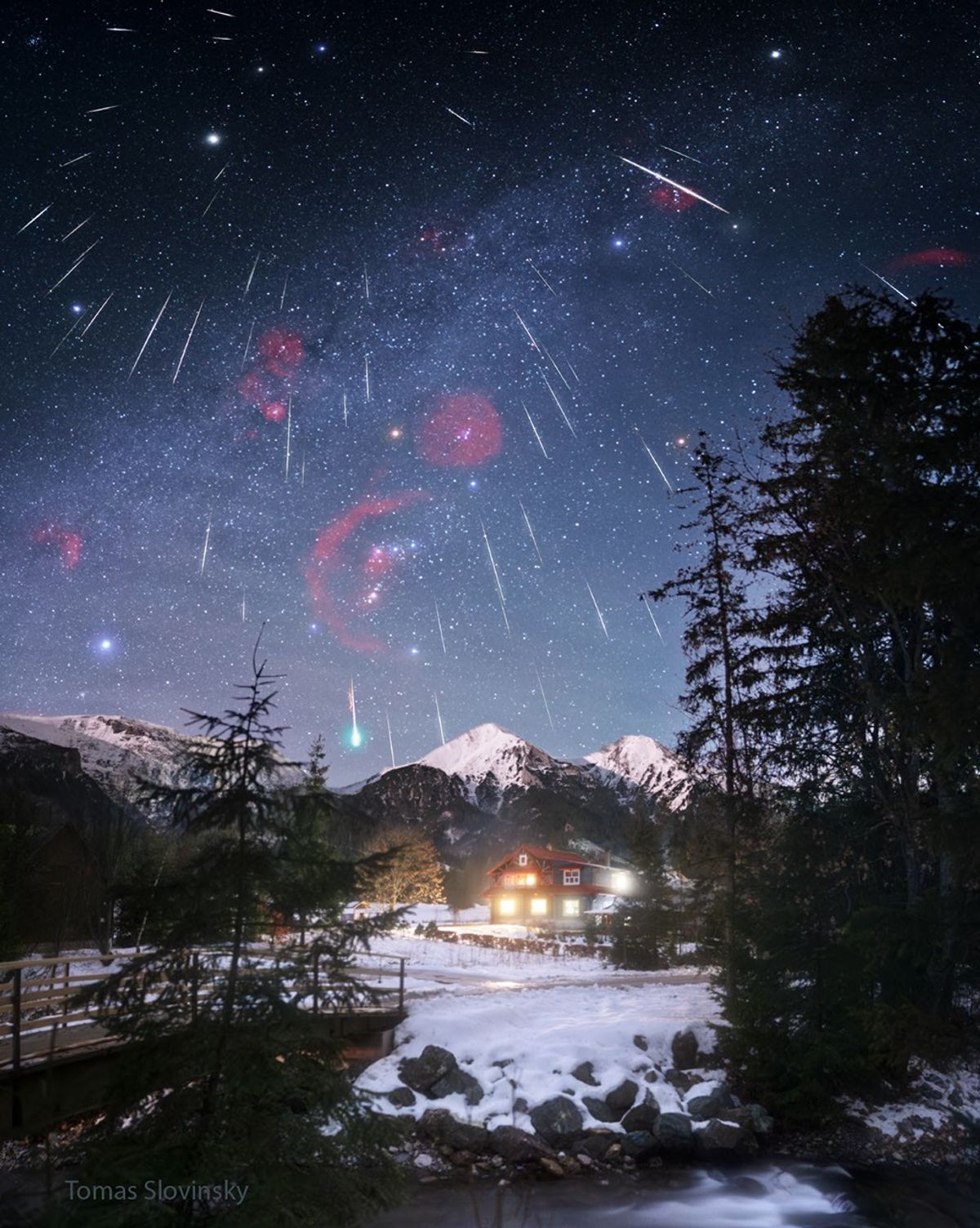
Selected image source ↗ APOD published December 15, 2025. Credit: Tomáš Slovinský. A publication-date match, not a photo taken on your date. Independent of NASA.
Behind the original result
Read the original APOD for the astronomer’s explanation and full image credits. Its text is preserved in the archive as published.
Where are all of these meteors coming from? In terms of direction on the sky, the pointed answer is the constellation of Gemini. That is why the major meteor shower in December is known as the Geminids -- because shower meteors all appear to come from a radiant toward Gemini. Three dimensionally, however, sand-sized debris expelled from the unusual asteroid 3200 Phaethon follows a well-defined orbit about our Sun, and the part of the orbit that approaches Earth is superposed in front of the constellation of Gemini. Therefore, when Earth crosses this orbit, the radiant point of falling debris appears in Gemini. Featured here is a composite of many images taken over the past few days through dark skies from Slovakia and capturing the snow-covered peaks of the Belianske Tatra mountains Numerous bright meteor streaks from the Geminids meteor shower are visible. Orion is visible above the horizon, while the bright star nearest the radiant is Castor. APOD Review: RJN's Night Sky Network Lecture
Image credit: Tomáš Slovinský
Updated · APOD entries through