December 14, 2025
December 14, 2025
A little universe, just for you
Free PNG · 1080 × 1350 · No account needed
Image rights and credit requirements apply when sharing or reusing imagery.
Your celebration date stays the same. Each image keeps its actual publication date.
Selected image source ↗ APOD published December 14, 2025 · Video still. Full image credits are on the original APOD entry below. A publication-date match, not a photo taken on your date. Independent of NASA.
Read the original APOD for the astronomer’s explanation and full image credits. Its text is preserved in the archive as published.
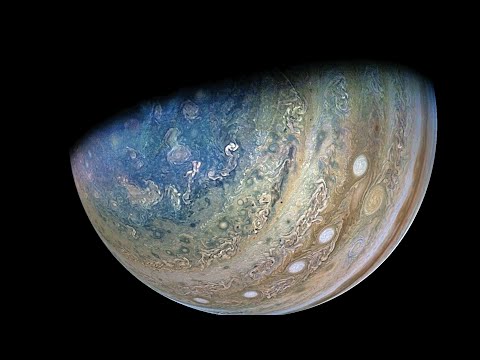
What would it be like to fly over the largest moon in the Solar System? In 2021, the robotic Juno spacecraft flew past Jupiter's huge moon Ganymede and took images that have been digitally constructed into a detailed flyby. As the featured video begins, Juno swoops over the two-toned surface of the 5,000-km wide moon, revealing an icy alien landscape filled with grooves and craters. The grooves are likely caused by shifting surface plates, while the craters are caused by violent impacts. Continuing on in its orbit, Juno then performed its 34th close pass over Jupiter's clouds. The digitally-constructed video shows numerous swirling clouds in the north, colorful planet-circling zones and bands across the middle -- featuring several white-oval clouds from the String of Pearls, and finally more swirling clouds in the south.
Updated · APOD entries through