December 13, 2025
December 13, 2025
A little universe, just for you
Free PNG · 1080 × 1350 · No account needed
Image rights and credit requirements apply when sharing or reusing imagery.
Your celebration date stays the same. Each image keeps its actual publication date.
Selected image source ↗ APOD published December 13, 2025. Full image credits are on the original APOD entry below. A publication-date match, not a photo taken on your date. Independent of NASA.
Read the original APOD for the astronomer’s explanation and full image credits. Its text is preserved in the archive as published.
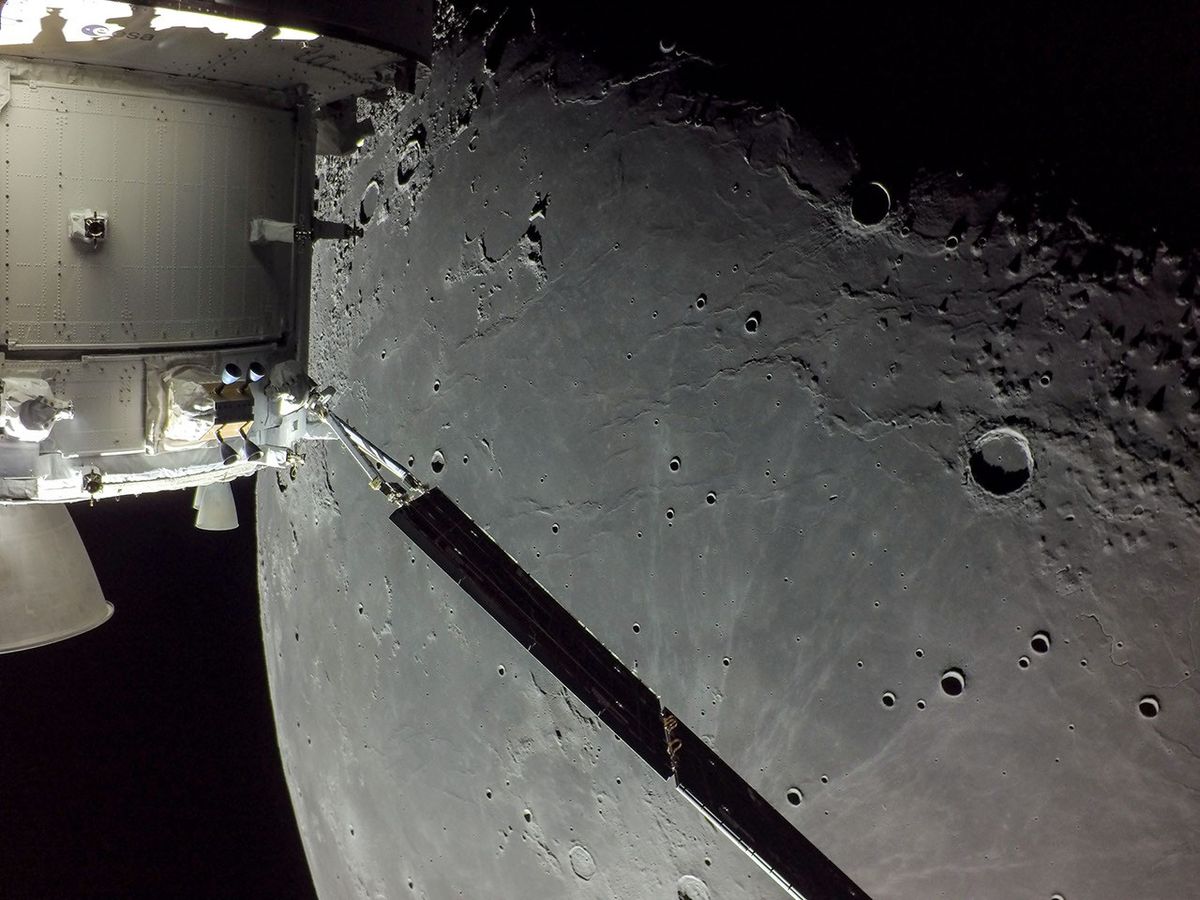
On December 5, 2022, a camera on board the uncrewed Orion spacecraft captured this view as Orion approached its return powered flyby of the Moon. Beyond one of Orion's extended solar arrays lies dark, smooth, terrain along the western edge of the Oceanus Procellarum. Prominent on the lunar nearside Oceanus Procellarum, the Ocean of Storms, is the largest of the Moon's lava-flooded maria. The lunar terminator, the shadow line between lunar night and day, runs along the left of this frame. The 41 kilometer diameter crater Marius is top center, with ray crater Kepler peeking in at the edge, just right of the solar array wing. Kepler's bright rays extend to the north and west, reaching the dark-floored Marius. By December 11, 2022 the Orion spacecraft had returned to its home world. The historic Artemis 1 mission ended with Orion's successful splashdown in planet Earth's water-flooded Pacific Ocean. Watch: The Geminid Meteor Shower
Updated · APOD entries through