December 11, 2025
December 11, 2025
A little universe, just for you
Free PNG · 1080 × 1350 · No account needed
Image rights and credit requirements apply when sharing or reusing imagery.
Your celebration date stays the same. Each image keeps its actual publication date.
Selected image source ↗ APOD published December 11, 2025. Credit: Vikas Chander. A publication-date match, not a photo taken on your date. Independent of NASA.
Read the original APOD for the astronomer’s explanation and full image credits. Its text is preserved in the archive as published.
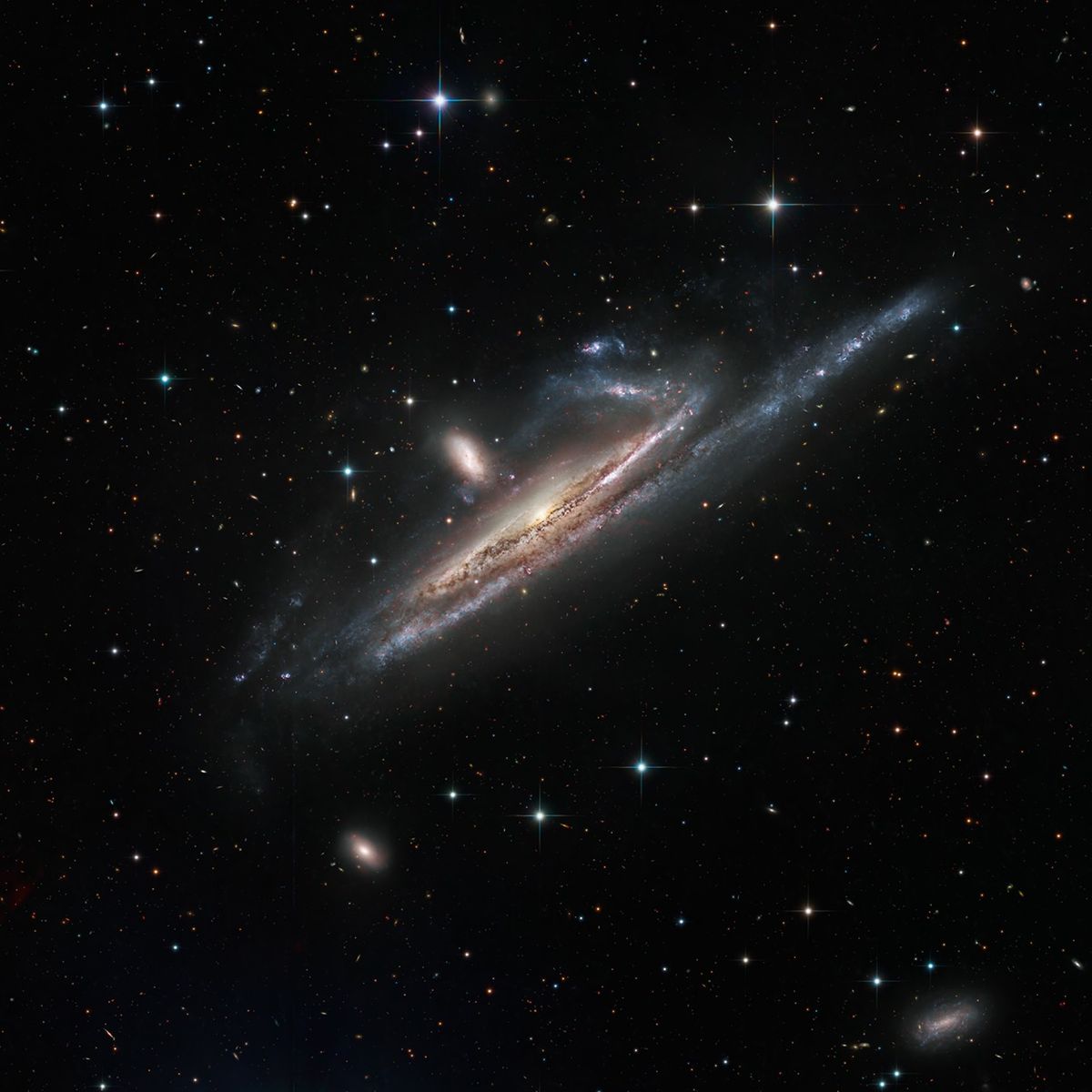
Large galaxies grow by eating small ones. Even our own galaxy engages in a sort of galactic cannibalism, absorbing small galaxies that are too close and are captured by the Milky Way's gravity. In fact, the practice is common in the universe and illustrated by this striking pair of interacting galaxies from the banks of the southern constellation Eridanus, The River. Located over 50 million light years away, the large, distorted spiral NGC 1532 is seen locked in a gravitational struggle with dwarf galaxy NGC 1531, a struggle the smaller galaxy will eventually lose. Seen nearly edge-on in this sharp image, spiral NGC 1532 spans about 100,000 light-years. The NGC 1532/1531 pair is thought to be similar to the well-studied system of face-on spiral and small companion known as M51.
Image credit: Vikas Chander
Updated · APOD entries through