August 28, 2026
August 28, 2026
A little universe, just for you
Free PNG · 1080 × 1350 · No account needed
Image rights and credit requirements apply when sharing or reusing imagery.
Your celebration date stays the same. Each image keeps its actual publication date.
Selected image source ↗ APOD published August 28, 2026. Credit: Osvaldo Castillo. A publication-date match, not a photo taken on your date. Independent of NASA.
Read the original APOD for the astronomer’s explanation and full image credits. Its text is preserved in the archive as published.
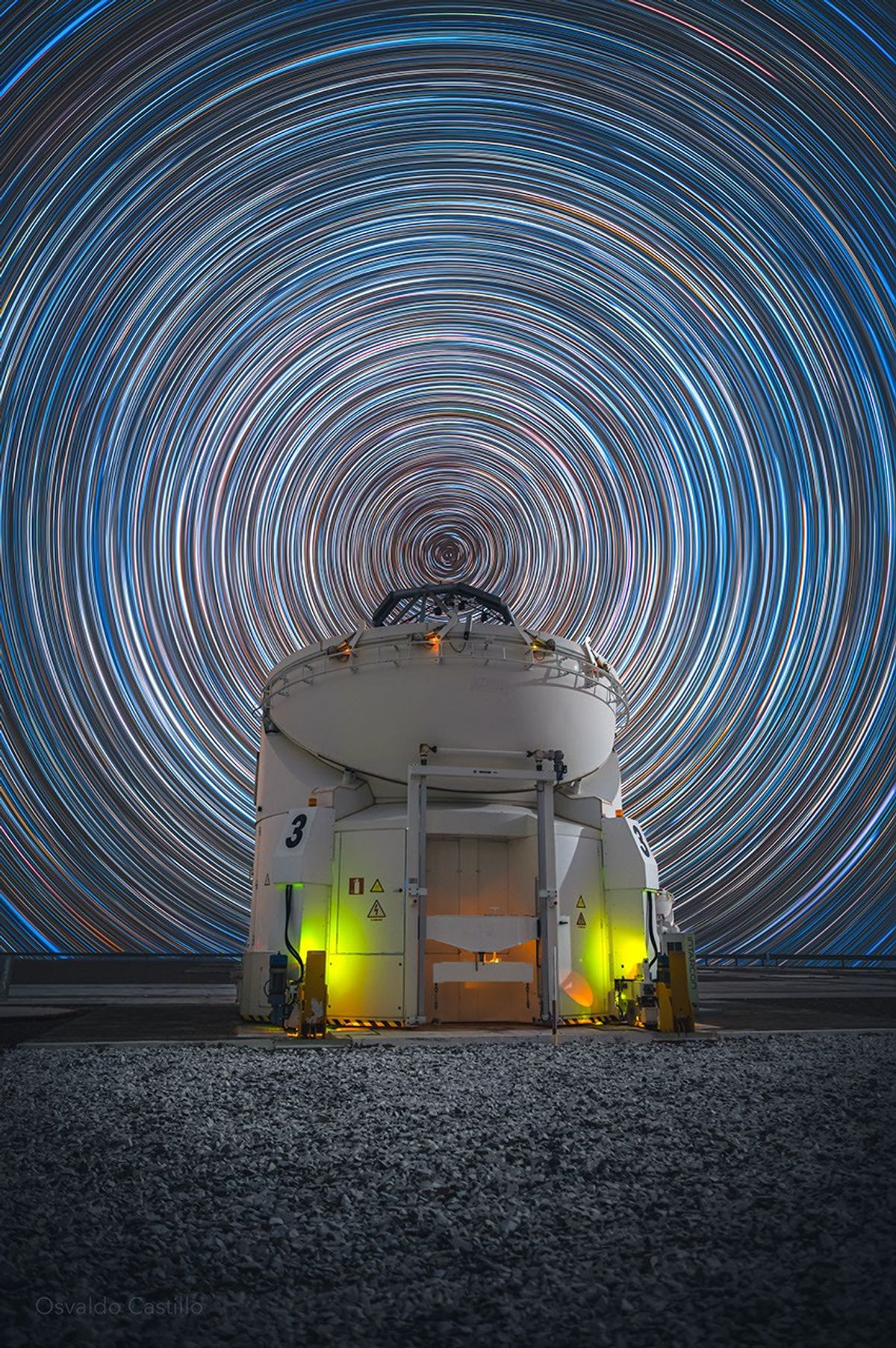
At the latitude of ESO's Paranal Observatory in Chile, about 25 degrees south, Earth's rotation moves the planet's surface eastward at over 1,500 kilometers per hour. And while that's faster than the speed of sound at sea level, the motion is imperceptible. Still, that motion can be revealed in the apparent rotation of the night sky by photographing star trails. This star trail image was composed from a digital stack of 300 consecutive 25-second exposures made with a camera fixed to a tripod to trace the star trail arcs. The graceful arcs are concentric and centered at the south celestial pole, the southern hemisphere extension of Earth's axis of rotation into space. One of the observatory's operating 1.8 meter auxiliary telescopes, AT 3, appears beneath the south celestial pole, faintly illuminated in the foreground of this well-planned scene from a rotating planet. Growing Gallery: Lunar Eclipse of 2026 August 28 APOD's main NASA site is moving: From apod.nasa.gov to science.nasa.gov/apod
Image credit: Osvaldo Castillo
Updated · APOD entries through