August 25, 2026
August 25, 2026
A little universe, just for you
Free PNG · 1080 × 1350 · No account needed
Image rights and credit requirements apply when sharing or reusing imagery.
Your celebration date stays the same. Each image keeps its actual publication date.
Selected image source ↗ APOD published August 25, 2026. Credit: Tim Martin. A publication-date match, not a photo taken on your date. Independent of NASA.
Behind the original result
Read the original APOD for the astronomer’s explanation and full image credits. Its text is preserved in the archive as published.
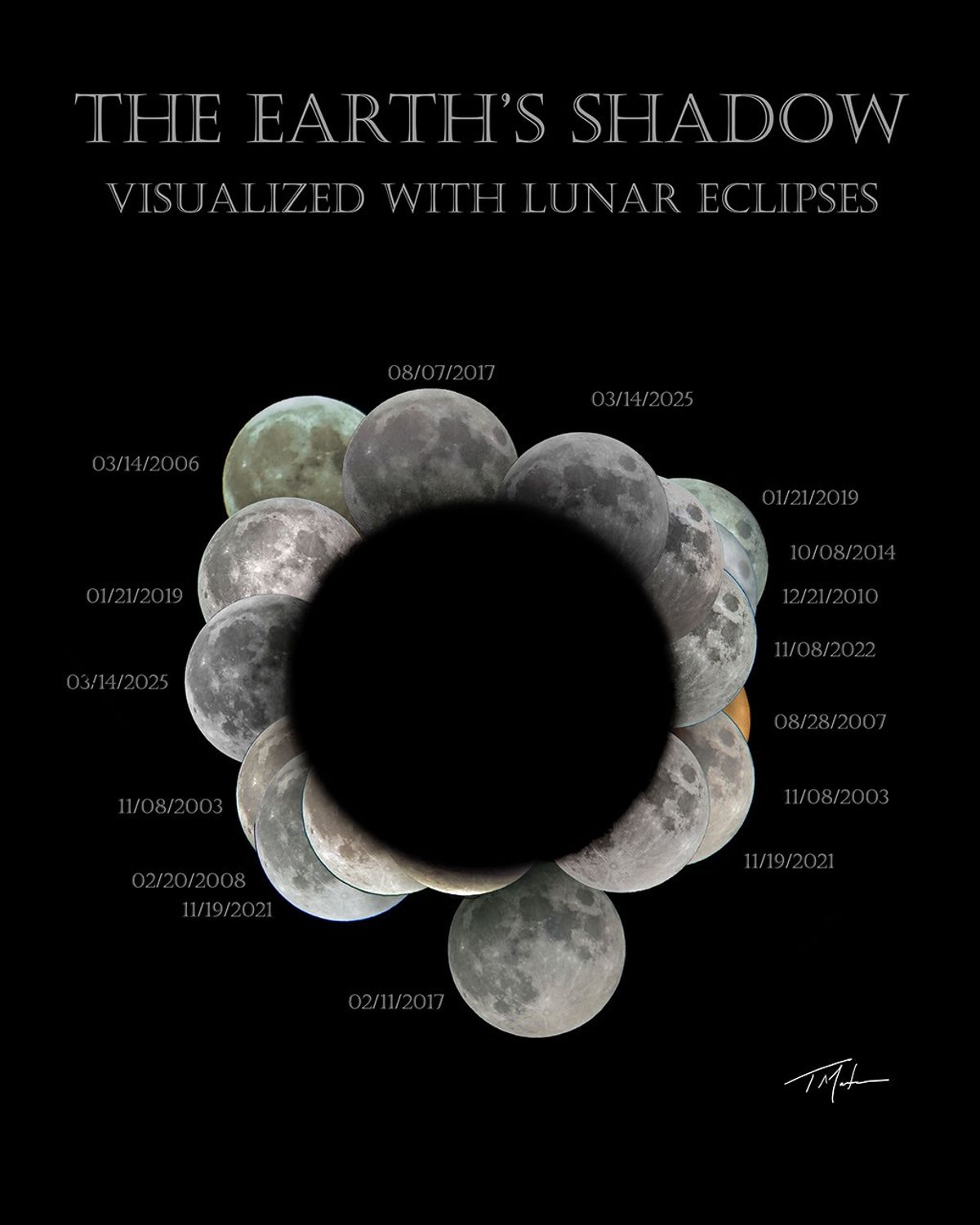
What’s creating this giant hole in space? This is not a black hole — it’s a shadow. It’s Earth’s shadow. Since at least the time of Aristotle, people have noted that Earth's dark shadow on the Moon during a partial lunar eclipse is circular -- although never a whole circle. Using modern digital technology, though, the images of multiple lunar eclipses can be combined to show Earth's complete shadow. The featured image compilation by a perseistent astrophotographer is constructed from 22 years of lunar eclipses. The Moon is not eclipsed every month (moon-th) because the Moon's orbit is slightly tilted relative to Earth's orbit. Close inspection of some lunar eclipse images shows a faint blue band where Earth’s atmosphere filters out more red sunlight than blue. Later this week, a new lunar eclipse will occur and will be best visible in parts of North and South America, Europe, and Africa. APOD's main NASA site is moving : From apod.nasa.gov to science.nasa.gov/apod
Image credit: Tim Martin
Updated · APOD entries through