August 18, 2026
August 18, 2026
A little universe, just for you
Free PNG · 1080 × 1350 · No account needed
Image rights and credit requirements apply when sharing or reusing imagery.
Your celebration date stays the same. Each image keeps its actual publication date.
Selected image source ↗ APOD published August 18, 2026. Credit: Jakub Kuřák. A publication-date match, not a photo taken on your date. Independent of NASA.
Read the original APOD for the astronomer’s explanation and full image credits. Its text is preserved in the archive as published.
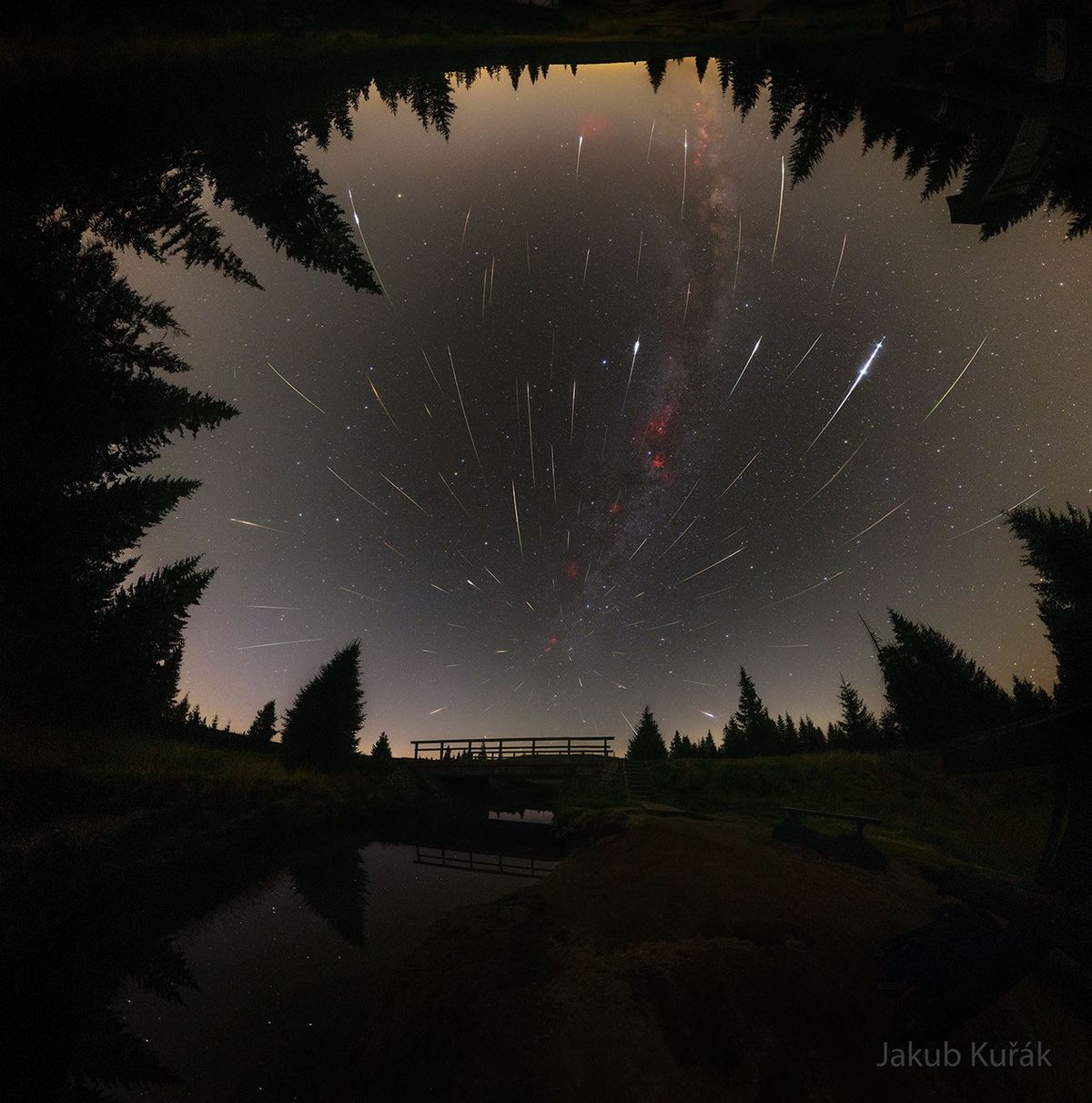
This was a good year for the Perseids meteor shower. A key reason was the Moon was absent from lighting up Earth's night sky so that more meteors were visible than usual. Where was the Moon? It was busy visiting the Sun. Near the Perseids peak, the Moon moved directly in front of the Sun and created a total solar eclipse visible from Greenland and Spain. The Perseids occur when the Earth collides with a stream of Sun-orbiting debris cast off by Comet Swift-Tuttle. Perseid meteors, although typically only the size of a sand grain, tend to be fast and bright because Swift-Tuttle's debris orbits the Sun in a direction partly opposite Earth's orbital motion. In the featured image compilation, accumulated over several nights from Jizerka in the Czech Republic, the Perseids meteor streaks can be traced back to a single location on the sky -- its radiant in Perseus. Gallery: Perseids Meteor Shower of 2026
Image credit: Jakub Kuřák
Updated · APOD entries through