April 4, 2026
April 4, 2026
A little universe, just for you
Free PNG · 1080 × 1350 · No account needed
Image rights and credit requirements apply when sharing or reusing imagery.
Your celebration date stays the same. Each image keeps its actual publication date.
Selected image source ↗ APOD published April 4, 2026. Full image credits are on the original APOD entry below. A publication-date match, not a photo taken on your date. Independent of NASA.
Read the original APOD for the astronomer’s explanation and full image credits. Its text is preserved in the archive as published.
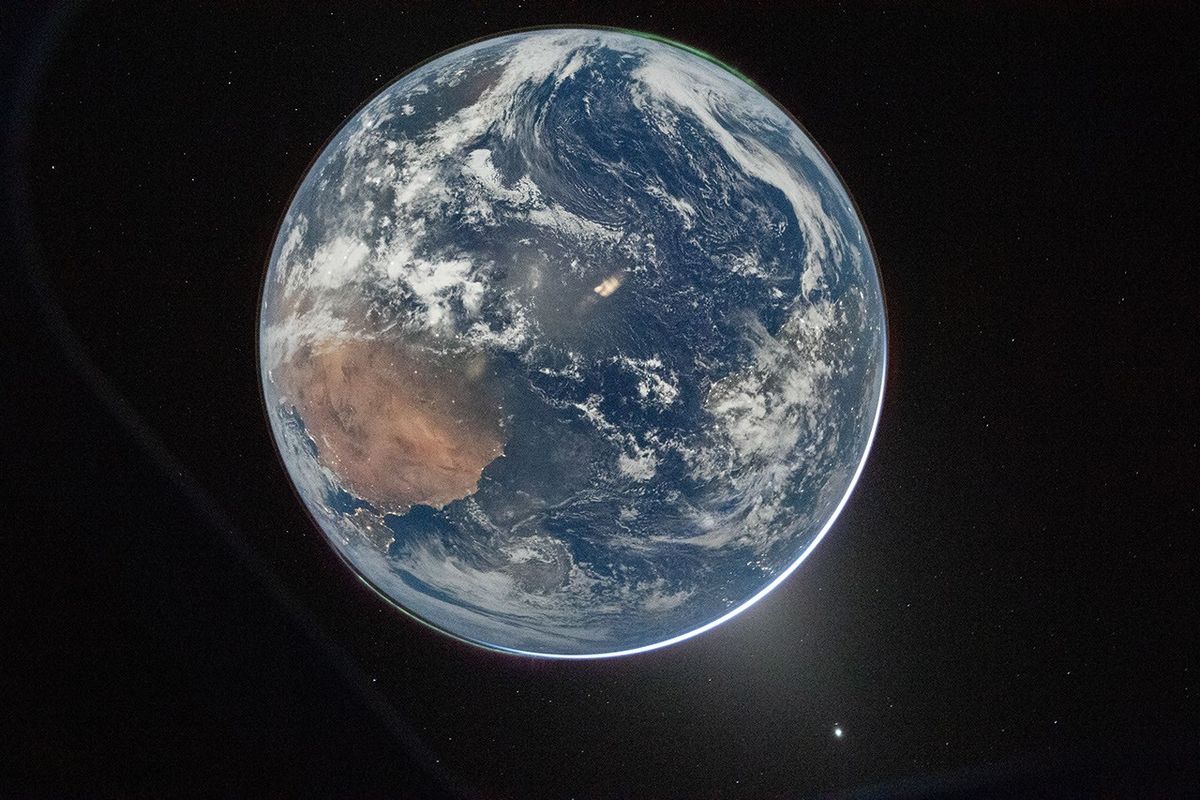
From pole to pole our fair planet is captured in this snapshot from space, an evocative image from a window of the Orion spacecraft Integrity. From the spacecraft's perspective the Sun is moving behind Earth's bright limb along the lower right. Africa and the Iberian peninsula are in view on the pale blue planet's surface, while aurorae crown Earth's south and north poles at top right and bottom left. Commander Reid Wiseman took the historic picture on Artemis II mission flight day 2 (April 2), after the completion of the planned translunar injection burn. That burn boosted the spacecraft out of Earth orbit, sending Integrity and crew on a trajectory that will take them around the Moon and back again. That's a journey humans last made over 50 years ago. (Editor's note: Venus is photobombing Wiseman's historic pic. Currently appearing in our western skies after sunset, the inner planet is in the frame below and right of Earth's bright limb, immersed in a faint band of zodiacal light.)
Updated · APOD entries through