April 17, 2026
April 17, 2026
A little universe, just for you
Free PNG · 1080 × 1350 · No account needed
Image rights and credit requirements apply when sharing or reusing imagery.
Your celebration date stays the same. Each image keeps its actual publication date.
Selected image source ↗ APOD published April 17, 2026. Credit: Arnaud Malleval. A publication-date match, not a photo taken on your date. Independent of NASA.
Read the original APOD for the astronomer’s explanation and full image credits. Its text is preserved in the archive as published.
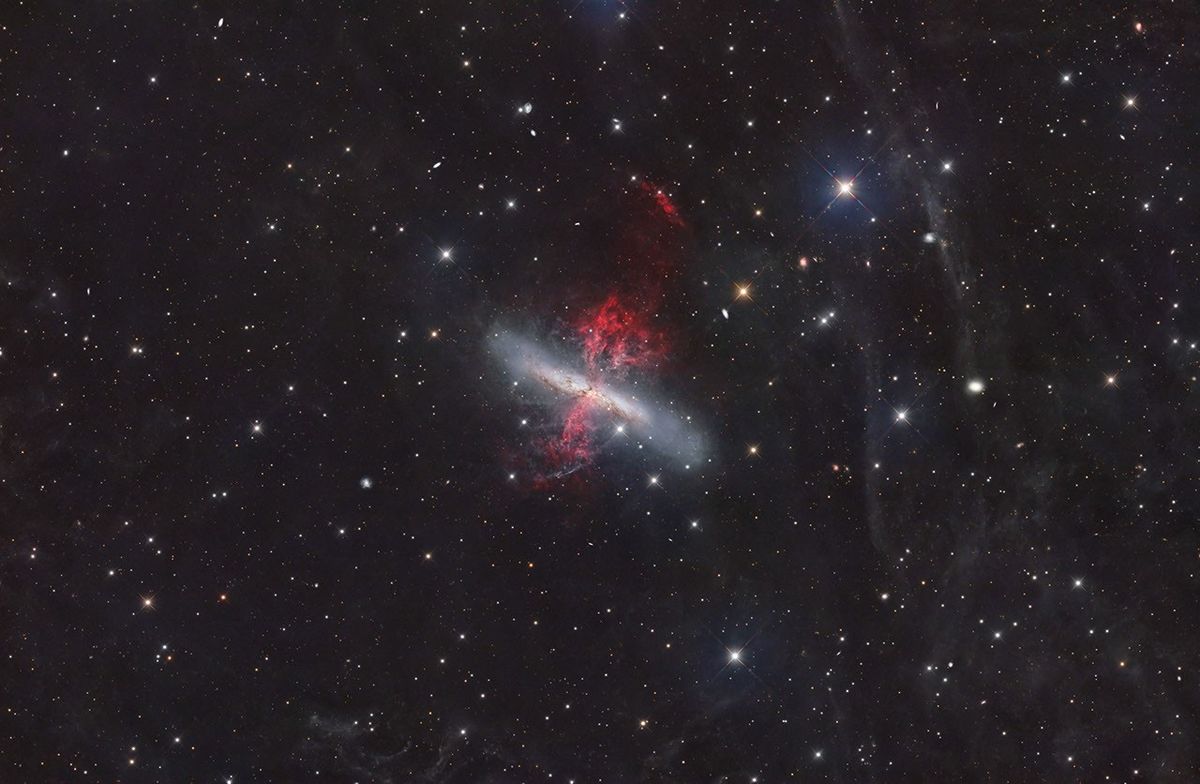
Messier 82 is a starburst galaxy with a superwind. In fact, through supernova explosions and powerful winds from massive stars, the burst of star formation in M82 is driving a prodigious outflow. Evidence for the superwind from the galaxy's central regions is clear in the sharp telescopic portrait. The composite image includes 33 hours of narrowband data, highlighting emission from long outflow filaments of atomic hydrogen gas in reddish hues. Some of the gas in the superwind, enriched in heavy elements forged in the massive stars, will eventually escape into intergalactic space. Triggered by a close encounter with nearby large galaxy M81, the furious burst of star formation in M82 should last about 100 million years or so. Also known as the Cigar Galaxy for its elongated visual appearance, M82 is about 30,000 light-years across. It lies 12 million light-years away near the northern boundary of Ursa Major.
Image credit: Arnaud Malleval
Updated · APOD entries through